Arizona State University is among eight universities selected to lead a national initiative focused on preparing the next generation of workers to advance American manufacturing.



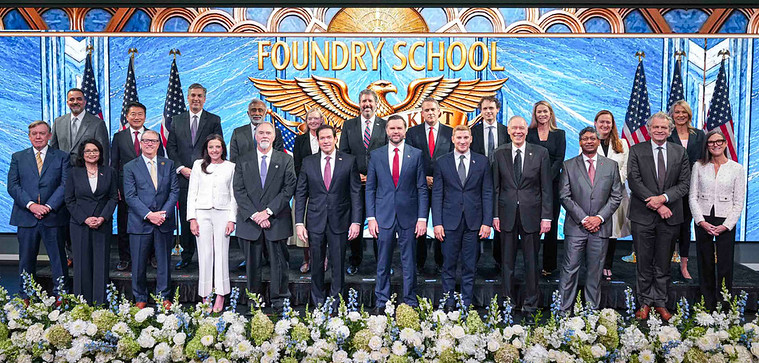
The Foundry School, a U.S. Department of State initiative in partnership with the U.S. Department of Labor, was announced today in Washington, D.C., by Vice President J.D. Vance. The school is designed to develop and train the workforce America will need to prepare the next generation of entrepreneurs, engineers, inventors and industrial leaders to build and operate advanced manufacturing enterprises.
ASU President Michael Crow joined the vice president, Under Secretary of State for Economic Affairs Jacob Helberg, and other university presidents for the announcement along with ASU students from the Ira A. Fulton Schools of Engineering who were invited to attend.
“This is about universities and industry working together to accelerate all things associated with enhancing workforce preparation, enhancement and competitiveness,” said ASU President Michael Crow. “ASU has been asked to be a part of this effort to help create the conditions to make sure the United States continues to be a global leader in driving the economy of the future, and we are glad to be of service.”
The Foundry School will rely on deep collaboration among industry, government and higher education. Across the eight universities, the program will run 17 sessions, each taught by founders and CEOs from advanced manufacturing enterprises. Manufacturers will share practical expertise developed through building and scaling industrial enterprises, while executives help teach students about areas including materials, precision production, automation, supply chains, factory economics and industrial leadership. These leaders will be drawn from the United States, the Republic of Korea, Japan, Taiwan and India.
ASU brings critical infrastructure — both physical and human — combined with proven industry partnerships to build the manufacturing workforce at scale. State-of-the-art facilities enable ASU’s faculty and researchers to advance their work at the highest levels, positioning the university as integral to the nation’s efforts to reshore the manufacturing of critical technologies. ASU training programs are moving workers directly into fab roles, and its facilities and faculty expertise together anchor several federally funded programs, positioning the university to help scale the nation’s next generation of manufacturing talent.
“We have all kinds of initiatives already underway at ASU,” said Crow. “We are deeply engaged in work related to training, to special R&D advancement, to advanced manufacturing, and to teaching, learning and discovery activities with industry. ASU is built for this assignment.”
The federal government will help expand the effort nationally by aligning resources, convening partners and supporting workforce pathways. Participating universities will translate industry expertise into education, embedding advanced manufacturing knowledge into curricula and workforce programs.
For ASU, the initiative is an opportunity to extend the Ira A. Fulton Schools of Engineering’s leading expertise in engineering education and research into a national effort to develop the people and capabilities needed for advanced manufacturing.
That commitment is already visible across the Fulton Schools: nearly all of its programs feed directly into the technologies and workforce reshoring depends on. The School of Manufacturing Systems and Networks, part of the Fulton Schools and housed in the 173,000-square-foot ISTB12 facility on ASU’s Polytechnic campus, is the clearest example, training students with skills that transfer across aerospace, microelectronics, medical devices, energy and more.
“Decisions made early in a design show up much later, in tooling, in yield and in whether a product can be manufactured at scale,” said Kyle Squires, dean of the Ira A. Fulton Schools of Engineering. “Teaching engineers to see that whole system is what our faculty do, and this partnership puts our students and emerging builders alongside the practitioners who solve those problems for a living.”
ASU’s Fulton Schools is the largest engineering school in the country, with nearly 33,000 students. ASU also ranks No. 2 among U.S. public universities (and in the top 15 nationally) for graduate employability, according to the Global Employability University Ranking and Survey. Employers worldwide favor ASU graduates for practical skills, digital literacy and job readiness.
This new national effort is intended to turn the resurgence of American manufacturing into an enduring capability by developing a workforce equipped with both technical knowledge and an understanding of how advanced industrial enterprises are built, operated and scaled.
Stanford University has played a key role in creating the Foundry School. Its broad expertise in fabrication facilities, robotics research and policy can help inform national conversations on manufacturing and workforce needs. The Ohio State University, Vanderbilt University, Washington University in St. Louis, Penn State, Georgia Tech, and the University of Kansas are the other universities that will lead this national initiative.