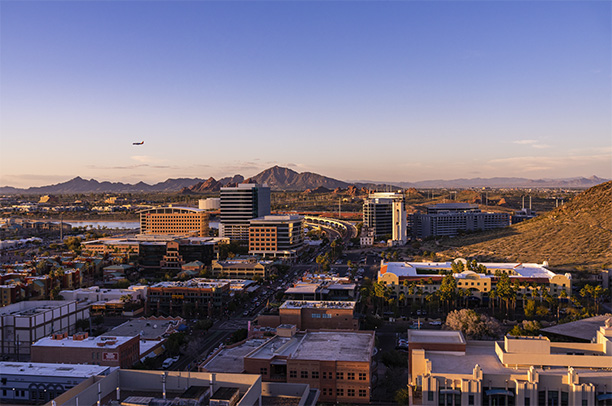
Tempe; photo courtesy of Downtown Tempe Authority
“A thriving downtown isn’t an accident — it’s mix, management and momentum. Tempe is writing that playbook in real time, blending strategic urban planning, intentional placemaking and collective community effort to ensure the next chapter is even brighter than the last,” says Lori Foster, LPM, president and CEO of Downtown Tempe Authority.







Observing that downtown districts across the U.S. have faced unprecedented challenges over the past several years, with the global pandemic reshaping how we work, live and connect, she points to economic shifts testing the resilience of small businesses while the change in consumer habits and desires demanded innovation. “Despite these hurdles,” she says, “downtown Tempe hasn’t just survived but, in fact, when you look closer, you see it’s on the cusp of thriving.”
To the downtown’s numerous advantages — centrally located, just 10 minutes from Phoenix Sky Harbor International Airport, surrounded by four major freeways, and accessible by light rail and streetcar; home to ASU, Hayden Butte (“A” Mountain), Tempe Town Lake, and five miles of bike paths; with mixed-use buildings offering residential above ground floor retail — she notes, “The downtown is clean, safe and sustainable.”
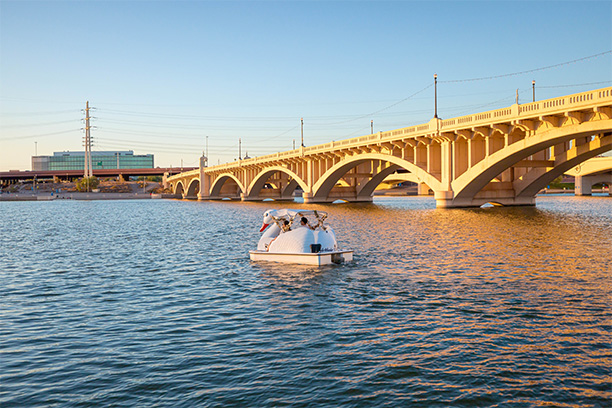
Paddle boat on Tempe Town Lake; photo courtesy of Downtown Tempe Authority
At the same time, she’s found downtown Tempe’s identity as a college town brings both energy and challenges, as many have equated the downtown’s prime with their own time at Arizona State University. However, she says, “Demographics of our city have shifted. Today, the average age of the downtown Tempe user is 32.91. While college students remain a vital part of our district’s character, they are joined by former ASU graduates who have chosen to stay, young working professionals, empty nesters, families and retirees.
“These changes bring diverse needs and opportunities, and downtown Tempe is evolving to meet them. Adapting to this shifting demographic means creating a downtown that balances the needs of student life with amenities and experiences that cater to a broader audience.”
To illustrate that, Foster points to downtown Tempe’s housing growth. Between 2010 and 2019, the number of housing units downtown grew by 569%, driven by the Urban Core Master Plan and transit-oriented projects along Rio Salado Parkway. Population density grew by more than 1,000 residents and 14,400 workers per square mile in less than a decade.
Tempe’s economic development team recognizes Mill Avenue’s significance as a defining part of Tempe’s identity and culture for more than a hundred years. Then the birth of Tempe Town Lake around the turn of this century brought a new wave of business investment and residential growth that continues to shape the city’s skyline and downtown experience today.
Over the past two decades, the city has seen sustained growth in Class A office space, mixed-use development, and multifamily housing along the lakefront and throughout downtown, with several major projects still underway. This evolution has diversified the downtown population and economic base beyond its historic connection to Arizona State University.
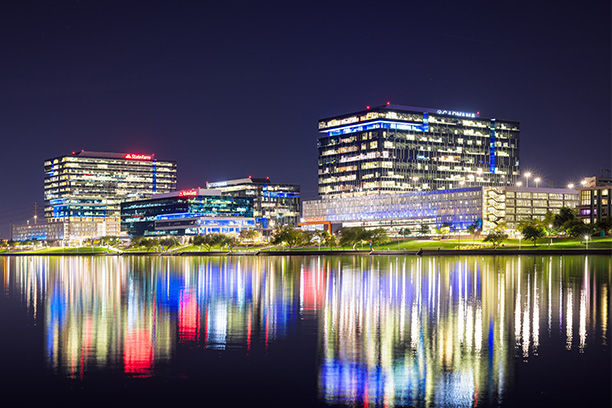
Tempe Town Lake at night; photo courtesy of Downtown Tempe Authority
Says Mayor Corey Woods, “ASU remains a significant driver of innovation, talent and activity in the area, and downtown Tempe has matured into a regional destination for business, dining, entertainment and urban living. New hotels, restaurants, retail, and community events continue to attract residents, visitors and employers.”
In Tempe, downtown growth is being driven by strong business investment and residential demand. “For companies looking to be located in an easily accessible, transit-oriented urban city, Tempe is an obvious choice,” says Mayor Woods. “As the city’s employment opportunities continue to grow, the support amenities follow. Downtown Tempe continues to see growth in housing, restaurants, retail and hospitality offerings that serve both residents and employees.”
In April 2024, the city embarked on the first renovation to its downtown core in more than 40 years. Now, two years later, that refresh effort is in its final phase, with construction set to be complete in July 2026. “The improvements included critical below-ground utility upgrades, which have helped the city plant 112 new trees, save 26 mature Ficus trees and support the long-term vitality of the district,” Mayor Woods reports. Renovations also included new and wider brick sidewalks with artistic treatments and ADA updates to improve the pedestrian experience. A new gateway sign was installed, providing a bold entrance to the district.
In tandem with this effort, the city has prioritized efforts to attract new local businesses to the area. Says Mayor Woods, “As a result of these initiatives, downtown Tempe is expected to welcome a new wave of restaurant and retail openings in late summer 2026, further strengthening the district’s economic momentum and visitor experience.”
Businesses Making It Work
Cassidy Lujan, owner of The Plant Mill on Mill Avenue, acknowledges the value of the infrastructure projects but gives more credit to the local businesses. “The vibrancy that actually draws people to Mill Avenue was built by independent businesses over decades, not by a construction crew or a corporate lease,” she says. In fact, pointing to the retail vacancy on Mill currently sitting around 12%, she says, “That’s not a coincidence. When you close a street for two years and redirect foot traffic away from small businesses that already operate on thin margins, you don’t get to take credit for the energy those businesses created. It’s old-fashioned Wild West grit.”
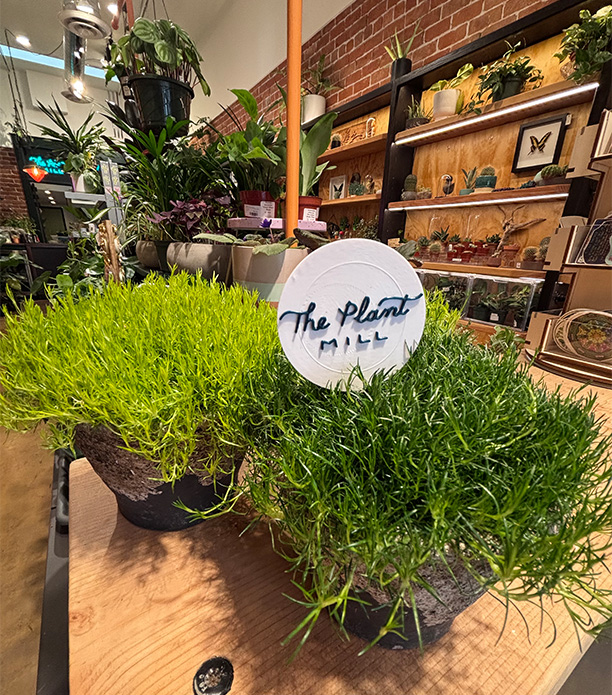
The Plant Mill; photo courtesy of Cassidy Lujan
Speaking to that spirit, Lujan explains The Plant Mill is a co-op of more than 25 local Arizona makers who need a physical home for their work, and even in “this economy, on this street, in the middle of a two-year construction project that has made it genuinely harder to run a business here, we have a waitlist of makers who want in.” Noting that every vendor in her shop is “independent, handmade or locally designed, and doing something that a big box story will never touch,” she says, “We contribute to this street’s identity the way all the independents before us did: by being real, being rooted and refusing to be replaced by something generic.”
Julian Wright, founder and CEO of Fork & Dagger Hospitality, encapsulates much of the above discussion. Having opened nine or ten food and beverage businesses on Mill Avenue over the course of 26 years, he says, “I feel personally vested and attached to Mill due to attending ASU and living in this area more than anywhere else. I also like how accessible and present our community leaders are here. I also think it’s the best place to live is Arizona.” Observing, “There’s nowhere else you can bike, hike, paddleboard, kayak, attend a sporting event, concert or art festival without having to get in a car. It’s also centrally located and close to the airport,” he says, “Probably the reason so many people are moving to the area.”
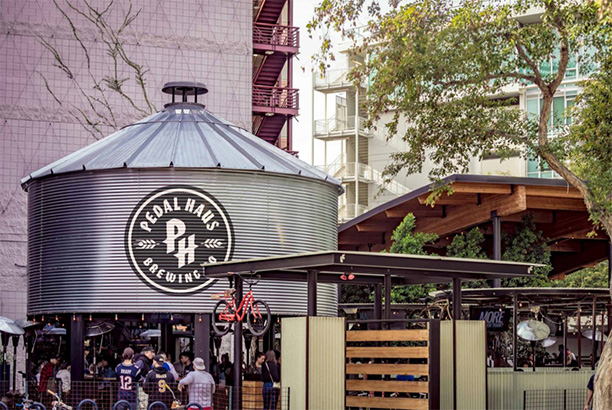
Pedal Haus Brewery; photo courtesy of Fork & Dagger Hospitality
More positive about the recent and ongoing city improvements, he specifically cites the new trees on Mill Avenue and the repaving “so the downtown will have a fresh look by the time the season starts.” Sharing, “I like downtowns in general as they’re very walkable and always provide good synergy with other similar businesses, not to mention there are lots of events and visitors, which creates a vibrant environment,” Wright says he is in the process of opening another tropical Mexican bar on Mill Avenue to add to his Pedal Haus Biergarten – which has been there 11 years – and Devil’s Hideaway. He sees the expected opening of several other bars and restaurants as adding to the synergy and making downtown a bigger draw.
Significant Trends and Strategies
Says DTA’s Foster, “The definition of a thriving downtown varies from person to person. For some, it is the buzz of busy restaurants and packed bars. For others, it’s walkable streets lined with filled storefronts. While I agree those are signs of vitality, I also believe a vibrant downtown is much more than just buildings and businesses.
“Vibrancy is about the experiences that inspire, the culture that resonates, and the careful planning that makes a downtown area welcoming, walkable, and full of life. It’s a feeling you can see, hear and feel, and it goes far beyond the surface. It’s what you find when you visit Downtown Tempe.
“Despite facing the same roadblocks experienced as countless other communities from coast to coast — and Arizona has certainly had its own challenges — downtown Tempe has embraced change, pivoted to meet new demands, and laid the groundwork for long-term success.”
Downtown Tempe is a participant in a comprehensive study conducted by the International Downtown Association entitled Value of U.S. Downtowns and Center Cities study, which analyzed 57 major U.S. downtowns on five key principles of urban centers: economy, inclusion, vibrancy, identity and resilience.
Foster relates the 2026 Value of Downtown Trends Report identified downtown Tempe as a
“growing” downtown — downtowns that have entered a phase of rapid development and change that provides new opportunities for downtown and the city as a whole. “And things in downtown Tempe are definitely undergoing a dramatic change,” she says.
The study found downtowns are evolving beyond 9-to-5 business centers. Visitors have returned to almost 90% of pre-pandemic levels, and the residential population grew by more than 33% from 2019 to 2023, proof that urban districts, much like Tempe, are rebounding through mixed-use energy and day-to-night activity. “The new trend,” Foster says, “will be growing the experience industry, expanding visitation and reengaging local and regional audiences who may need encouragement to ‘rediscover’ what downtown Tempe has to offer. Positioning downtown as the destination for fun, culture and unique experiences provides a way for meaningful new growth.”
Reporting that downtown Tempe is home to more than 165 street-level businesses, including 81 restaurants and bars, with 68% of the downtown street-level businesses being local and independently owned, Foster admits, “Retail has struggled downtown, and merchants have experienced difficult conditions over the last few years due to a combination of factors, including the ongoing impacts of pandemic recovery, streetcar construction, rotating vacancies, changing consumer behaviors, increased competition from other urban areas, and the continued streetscape construction activity.” However, since the beginning of 2025, 26 new businesses have opened with another 10 opened by fall 2026.
According to Foster, large firms account for 83% of all employment in Tempe’s downtown, yet small and young businesses are growing rapidly at 46% and 37%, respectively, reflecting both corporate strength and emerging entrepreneurial energy. Recent new tenants include Cognite, LPL Financial, Crest Insurance and Clifton Larson Allen.
Referring to the downtown Tempe streetscape project — the first refresh of Mill Avenue in 40 years — Mayor Woods says, “The improvements included critical below-ground utility upgrades, which have helped the city plant 112 new trees, save 26 mature Ficus trees and support the long-term vitality of the district.”
And Foster points out Downtown Tempe Authority’s signature events like the Tempe Festival of the Arts, Tempe Blooms, Fantasy of Lights Holiday Boat Parade and Street Parade, and the 2nd Sundays on Mill series bring the community together while supporting local businesses. “These activations don’t just attract visitors; they create lasting memories for millions of visitors annually, and drive business to local restaurants and retail shops. These signature events, combined with Tempe’s waterfront setting, ASU’s campus energy, and the city’s arts and nightlife scene, make Downtown Tempe a regional magnet that draws visitors from well beyond the Valley.”
Reporting that, collectively, downtown Tempe’s events contribute almost a $29 million economic impact, Foster says, “The energy and attendance at these events leaves little doubt that downtown Tempe is, indeed, thriving. In 2024 alone, Placer.ai data shows 2.5 million people made 15 million visits to downtown Tempe.”
Read all the downtowns’ stories.