As many of us know, business travel can be exciting, productive and professionally rewarding, but it can also be surprisingly disruptive to sleep. It’s not uncommon for travelling adults to report arriving at the hotel after a long flight, answering “just a few more emails,” eating dinner later than usual, and then lying awake in a room that doesn’t feel quite like home.







Sleep is highly responsive to context. Our brains take in environmental cues all day long, and those cues help determine when we feel alert, when we wind down and whether a space feels safe enough to rest deeply.
On a business trip, many of those cues change at once. There are the issues of the bed being unfamiliar, the sounds in the room, the lighting being different, and our schedule being off. On top of that, if the trip is high-stakes, we may find our mind rehearsing meetings, presentations or travel logistics long after our body is ready to sleep.
The good news is that better sleep on business trips is not about creating a perfect sleep environment. It is about creating enough familiarity that our brain can settle. With just a few intentional choices, it’s possible to have better nights’ sleep even when we’re on a business trip.
Protect the Bed as a Sleep Space
One of the biggest mistakes people make in hotel rooms is turning the bed into an office.
It makes sense. We arrive tired, kick off our shoes, open our laptop, and tell ourselves we are just going to respond to a few messages. But when we work in bed, our brain starts associating that space with alertness, problem-solving and performance. This is very similar to how we’ve also heard it’s not recommended to eat, watch TV or scroll endlessly in bed. Bed should cue our body for sleep, not productivity.
Most hotel rooms have a desk, and it is there for a reason. Use it! Even if it is not the ideal workstation, the separation is key. Or find a nearby cafe that has a vibe conducive to focus and work in. Anywhere but the bed!
Create a Travel Wind-Down Ritual
A good bedtime routine is not just for babies and kids. Adults need transition time, too.
On business trips, the day often ends abruptly. We may go from client dinners, networking events or late-night prep directly into bed. But sleep does not work like a light switch. It’s more like a dimmer. Our body needs a gradual reduction in stimulation before it can fully settle.
A simple travel wind-down routine can be short and realistic. Something like: Close the laptop, set the alarm, wash the face, brush the teeth, turn down the lights, and put the phone on the other side of the room or at least out of arm’s reach. These small steps tell our brain it’s time for sleep.
The key is not that the routine is elaborate. The key is that it be consistent. When our surroundings are unfamiliar, our habits can become the familiar part.
Pack Special ‘Work Pajamas’
This may sound a little silly and trivial, but it can be surprisingly effective: bring luxurious “work pajamas.”
Not pajamas familiarly worn while working, but pajamas that are reserved for work trips. Something soft, comfortable and a little elevated.
There is a psychological cue here. Putting them on sends a message to the brain: “This is what I wear when I travel for work and I sleep well.” If we say this and believe it to be true, over time this will build a neuropathway, and the sleep association of the pajamas will reinforce it.
Business travel can make people feel disoriented, rushed and out of their normal routine. A small ritual like changing into luxury, comfortable sleepwear can make a difference in our quality of sleep.
Bring a Portable White Noise Machine
Hotel rooms are unpredictable. We may hear elevators, street traffic, hallway conversations, ice machines, room doors closing, or the actual worst — an air conditioner cycling on and off throughout the night. Even if these sounds do not fully wake us, they can fragment our sleep and keep our body in a lighter, more alert state.
A portable white noise machine is one of the easiest ways to create consistency from one hotel to the next by helping to mask sudden noises that might otherwise pull us out of sleep.
Phone apps can work in a pinch, but a small travel white noise machine is often better because it allows the phone to stay out of the sleep equation (and the quality of the white noise is often better). If the phone is the source of our sound machine, it is also right there should we wake in the night, a temptation to check the time, read a message or mentally reenter work mode.
Use an Eye Mask
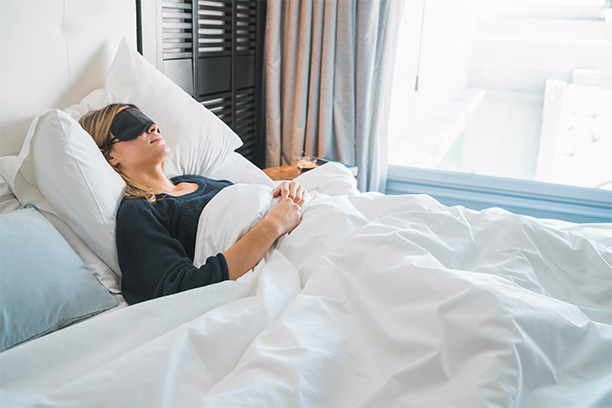
Hotel rooms are notorious for sneaky light. There may be a glowing thermostat, a blinking smoke detector, hallway light peeking through the door or curtains that never quite close all the way. Even small amounts of light can make it harder for our body to stay in a deep sleep.
An eye mask is a simple, low-effort and low-cost solution. It helps create darkness no matter what the room is doing. It also becomes another travel cue: when the mask goes on, the day is done.
It’s important to choose one that feels comfortable and does not press too tightly on the face — rather than just adding another thing to tolerate.
Bring a Pillowcase from Home
Some people love traveling with a pillow from home, but a pillowcase is a much easier option. This brings a small piece of home into an unfamiliar room. It feels familiar against our skin, and it smells familiar, even if only subtly. It can make the hotel bed feel less anonymous and more personal.
This is especially helpful for people who are sensitive to hotel linens, strong laundry scents or the slightly sterile feeling of sleeping somewhere new. A pillowcase takes up almost no space in a suitcase, but it really can create a sense of comfort.
Use Sleep Fragrance as a Cue
Scent is closely tied to memory and emotion. A familiar sleep fragrance can become a psychological cue that tells our body it is time to wind down.
This could be a linen spray, a roll-on oil, a small sachet or a lightly scented lotion used only at bedtime. The specific scent matters less than creating an association that says, “This smell means rest.”
Best to keep it subtle. Some popular options include lavender, chamomile and jasmine.
Get Outside Early in the Morning
One of the most helpful things we can do for sleep while traveling actually happens in the morning: Get outside early, preferably just when the sun is coming up, and build it into the travel routine. Morning light helps cue alertness during the day, which then supports better melatonin production and sleep pressure at night.
A morning routine is especially grounding when traveling. Business trips often involve a lot of external demands: meetings, schedules, transportation, other people’s agendas. Starting the day with a few minutes outside gives us a moment of ownership before the day begins.
In Short …
In summary, when we’re looking at improving sleep while traveling, the goal is not to recreate our bedroom perfectly. That is rarely realistic. The goal is to give our body enough consistent cues that it knows what to do.
This includes working at the desk, not in bed. Changing into pajamas that feel like part of our travel ritual. Using white noise and an eye mask to reduce environmental disruptions. Bringing our own pillowcase. Adding a subtle sleep fragrance and getting outside early in the morning.
Yes, these are all small things, but small things matter because sleep is built on patterns. For those who travel often, routines become portable. They tell our nervous system, “We know how to rest here, too.”
Plus, when we sleep better on business trips, we don’t just feel better at night. We think more clearly, communicate more effectively, regulate stress more easily, and show up as a more grounded version of ourselves the next day.
 Chrissy Lawler, LMFT, is in the trenches. Founder of The Peaceful Sleeper, she’s a licensed marriage and family therapist with more than 15 years of experience and 467,000 Instagram followers, who has helped more than 400,000 families worldwide (including celebrity and pro-athlete clients) with real-talk sleep tips that actually work. Her USA Today best-selling book, The Peaceful Sleeper: An Intuitive Approach to Baby Sleep, offers an attachment-based, research-backed approach to baby sleep to help the whole family’s mental health.