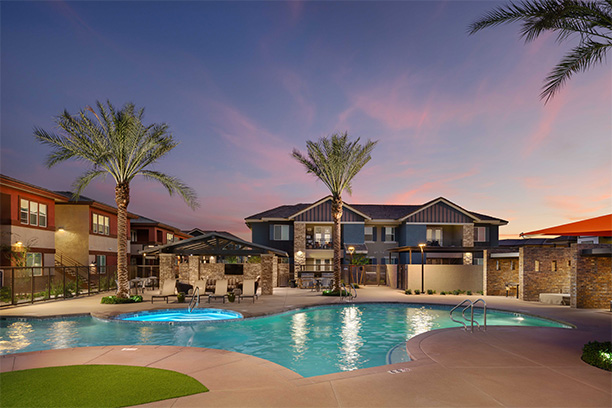
Everly at Morrison Ranch, courtesy of P.B. Bell
Across the Valley, the multifamily real estate market has faced oversupply since COVID. However, Phoenix apartment absorption is now outpacing deliverables for the first time in five years, which signals the beginning of what we expect will be a gradual recovery. It’s important to keep in mind that the pace and success of this recovery vary greatly by submarket, and affordability is at the forefront of renters’ minds.






Oversupply and How It Is Impacting Submarkets Today
The oversupply issue has impacted all pockets of the Valley; however, some areas have felt it more than others. The West Valley, Downtown Phoenix, Tempe and portions of the Southwest Valley have vacancies exceeding 10% (CoStar via Solex CRE, Jun ’26). Recovery in these markets is expected to lag until late 2026 or potentially into 2027.
Looking closely at one of these markets, many investors have deemed the West Valley as “up and coming” and have poured a lot of funding and resources into the area, hoping for a high return on investment. However, demand has not yet caught up with the pace of deliveries. This has led to them offering aggressive concessions to attract renters, including 10–15 weeks of free rent on new leases.
Submarkets That Are Recovering Faster
On the flip side, parts of the Valley are showing signs of stabilization and recovery. These areas include Old Town/North Scottsdale, Chandler, Gilbert and the Camelback/Biltmore corridor.
The East Valley and North Scottsdale corridors maintain vacancies near or below 7% and are expected to be among the first to return to positive rent growth (CoStar via Solex CRE, Jun ’26). This is because there are higher barriers for new construction, which has led to less oversupply relative to demand.
Affordability Meets Opportunity
Today, people are looking for affordability that goes beyond rent per square foot. Now, it’s more about the total monthly rent payment. Asking rents remain slightly negative year over year, declining between roughly 2.4% and 4.1% depending on the submarket.
So, developers are looking at a few creative options like smaller, efficient floor plans and ways to decrease total monthly housing costs to attract residents.
The job market in Phoenix is also expected to have a positive impact on the multifamily real estate market. The Phoenix Metro added approximately 41,300 jobs over 12 months (July 2025 – July 2026; U.S Bureau of Labor Statistics), and population growth is projected at approximately 1.5% in 2026 (Eller Q2 ’26 forecast). Also, long-term economic drivers, including semiconductor investments from companies such as TSMC, Intel and Amkor, remain positive for housing demand.
Investing in the Valley’s Future
While oversupply continues to pressure some Valley apartment markets, strong job growth, population gains and slowing construction activity are creating the conditions for stabilization. Aggressive concessions and softened pricing create an attractive acquisition basis for disciplined, well-capitalized buyers before rent growth returns, making now a great time to invest.

Keagan Huerta is executive vice president of Investments at P.B. Bell. The team at P.B. Bell has navigated acquisitions, development, asset management and property management in-house for the past 50 years. The company recently announced a $125-million investment fund positioned to capitalize on recovery in the Phoenix Metro Area; backed by long-standing expertise in investing in the Valley, this vehicle targets the acquisition of Class A and B multifamily assets across Arizona that are supply constrained, with a primary focus on the high-barrier submarkets in the Phoenix metropolitan area.