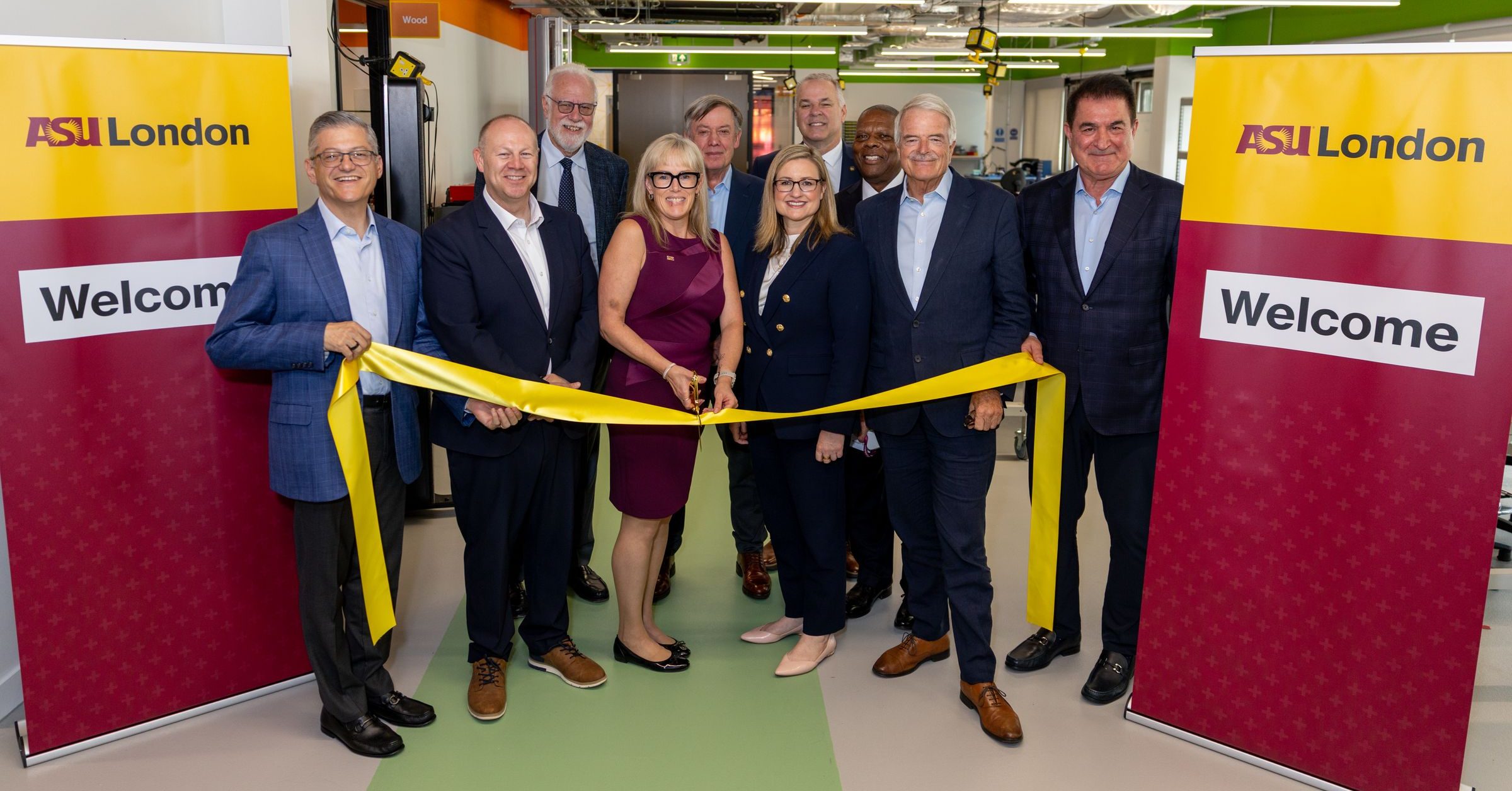
Michael Goodwin was less than a minute into his remarks when he made clear to the audience of 300 or so gathered for the opening of ASU London, a new independent, U.K.-degree-awarding higher education provider founded by ASU, exactly why they were there.







“We’re here to celebrate the opening of what we believe will become one of the pioneering new providers of higher education globally,” said Goodwin, managing director of ASU London.
“Our challenge-based learning approach, our innovative program design, our global student pathways and our commitment to training graduates so they have the skills to solve highly challenging, complex global problems is why we believe that we are creating a higher education proposition that’s fit for the future.”
The opening of ASU London was celebrated in an hourlong program at the Tait Building, part of the nearly 300-year-old Clerkenwell campus of City St. George’s, University of London, where ASU London is located.
As part of the program, Arizona State University President Michael Crow, Phoenix Mayor Kate Gallego and others, including two incoming students from the Phoenix area, were on hand to participate in panel discussions that delved into the promise and potential of ASU London.
ASU London offers six undergraduate degree programs: business management; computer science; electrical and electronic engineering; engineering with artificial intelligence; engineering with mechatronics systems; and global design engineering.
The 320 students studying this fall will be guided by U.K.-based faculty in collaboration with faculty from ASU’s top-ranked Ira A. Fulton Schools of Engineering and W. P. Carey School of Business.
And, as several speakers noted Wednesday, students can complete a three-year bachelor’s degree in London and then pursue an accelerated one-year master’s degree at ASU.
The ability to earn two degrees in as little as four years saves students time, reduces tuition costs and provides an international experience across two of the world’s leading higher education systems.
“I don’t think this has happened before, and that is what is so extraordinary,” said Sir Malcom Grant, grant chair of ASU London’s board of trustee directors, a senior advisor to Crow and part of London’s university system since 1972. “We can take students internationally, give them three years’ education here in London, and then they may go onto a master’s program (at ASU).
“Being able to offer students this extraordinary opportunity … I am totally committed to this.”
Crow said ASU London is the “manifestation” of ASU’s eighth design aspiration: Engage globally.
“We think that at the end of the day, a university which is local only will be lesser only,” Crow said. “A university which is focused on a small (number) of ways that people learn will be a lesser institution. An institution that is single culture is going to be a failure. An institution that’s not connected to all the things that are going on around the world will not be successful.
“This is a way for us to innovate. It’s a way for us to connect. It’s a way for ASU to be globally engaged.”
Goodwin said ASU’s commitment to innovation is seen in ASU London’s hands-on, project-based learning approach, in which students will work with industry partners, as well as its ability to offer students two degrees in four years.
“It’s a different journey,” Goodwin said. “If you’re a student, we’re bringing different choices. And I think that’s a really powerful message, and one that’s much needed at this moment in higher education.”
James Woods, who is studying business management after graduating from Brophy College Preparatory in Phoenix this May, said everything about ASU London — from its learning approach to its global focus — convinced him to cross the pond to begin his college education.
“I feel as I come to London, it’s going to open up more opportunities for me to be a leader,” Woods said. “You’re surrounded by leaders. And what I particularly like is that they’re not just handing you a paper to work on. You’re actually working on a project. You’re given a purpose.
“I think that’s going to make you learn better, it’s going to make you want to learn more and it’s going to make you excited for the future.”