Arizona has launched a collaborative satellite communications hub, a unique partnership that brings advanced technology from the lab to the rooftop and positions the state as a leader in space infrastructure innovation.


FreeFall Aerospace, a Tucson-based company, is working with Arizona State University and the University of Arizona on a satellite communications project featuring FreeFall’s All Sky Antenna ground terminal technology. Installed to support ASU’s SPARCS mission, among others, the system will enable research and testing to improve how teams connect with orbiting satellites.
The project combines industry technology and university research expertise, helping Arizona claim a larger stake in the rapidly growing national space economy. Arizona’s space sector has seen record investments and job growth in the past year, reflecting broader trends in U.S. space industry development. Technologies like the All Sky Antenna are helping support the growing demand for reliable satellite communications used in national security, scientific research, weather monitoring, and global connectivity.
“This collaboration is a strong example of Arizona’s space ecosystem at work,” said Dustin Blanchard, FreeFall Aerospace’s President & COO. “By working with ASU and the University of Arizona, we are facilitating a broader range of ecosystem participants with advanced satellite communications.”
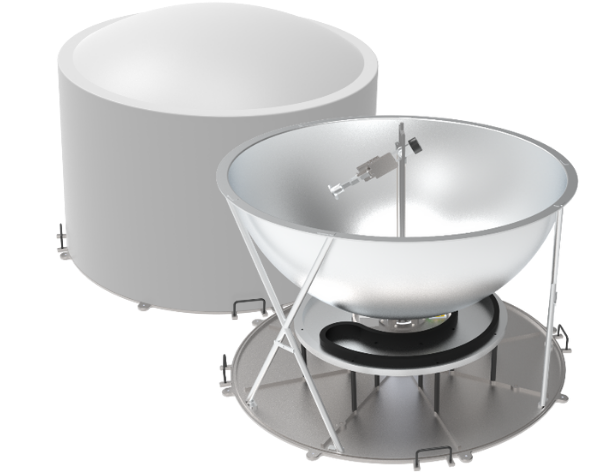
FreeFall’s All Sky Antenna is designed to efficiently connect with satellites in a variety of orbits. Unlike traditional satellite dishes, the All Sky Antenna features a low-profile design that can be conveniently installed on rooftops and within existing infrastructure, providing protection from environmental extremes and other threats. The system features rapid satellite tracking with a stationary reflector dish for low power and reduced maintenance. The technology allows researchers to communicate with satellites in orbits ranging from low Earth orbit to deep space with maximum efficiency. Its automated tracking helps teams quickly locate satellites, making better use of limited communication time.
The system has already been used to support communications with a range of satellite missions, including Arizona research efforts such as CatSat, the University of Arizona-led satellite mission that has received public attention for its student-driven innovation and launch.
“This project reflects the momentum building across Arizona’s space sector,” said Aman Chandra, Senior Engineer for Aerospace Systems at the University of Arizona. “By combining university research with industry-developed technology, we can accelerate innovation and expand opportunities for future satellite missions and communications systems.”
“This is precisely the kind of collaboration ASU/NewSpace was built to catalyze,” said Jim Bell, Regents Professor and Director of the ASU Space Technology and Science (NewSpace) Initiative. “By bridging faculty, staff, and students in ASU’s School of Earth and Space Exploration (SESE) and the Fulton Schools of Engineering with industry partners like FreeFall, we’re giving researchers unprecedented access to operational satellite communications technology — accelerating the discoveries and ventures that will define Arizona’s growing role in the new space age.” Radio astronomer and SESE Professor Danny Jacobs added that “The project is in collaboration with ASU’s Interplanetary Lab, which employs students to build, test, and operate small satellites. We look forward to adding this novel technology to our student-operated ground station facility. The students are excited to try out this new technology and see what it can do.”
Founded in 2016, FreeFall Aerospace develops antenna and communications systems for national security, scientific research, and commercial applications. The company operates an 8,000-square-foot office and laboratory facility in Tucson, where its team designs, tests, and builds technologies for space communications and remote sensing.
FreeFall maintains a close working relationship with the University of Arizona, whose expertise in radio astronomy and space science has helped inform several of the company’s technologies and capabilities.
As global demand for faster, more resilient satellite communications surges, driven by everything from commercial launches to national security, Arizona companies and universities are collaborating to build the infrastructure and talent needed for the next generation of space connectivity. With the All Sky Antenna ground terminal now operational, FreeFall is supporting future satellite missions and advancing national space goals. The collaboration reflects Arizona’s growing momentum as a center for space defense, aerospace research, satellite technology, and university-industry partnerships.