Psychological safety has become corporations’ ultimate magic cure-all. Teams underperforming? Build psychological safety. People not speaking up? More psychological safety. Ask ChatGPT for help with any team problem? You guessed it — psychological safety. It’s the ultimate irony: We’ve created groupthink around a concept designed to prevent groupthink.





Why did this happen? Because it sells. There’s a multimillion-dollar industry of workshops, books and training programs built on a simple idea: Make people feel safe, and they’ll speak up. But people don’t always behave as we expect, so we should adapt frameworks to fit reality, not force reality to fit our frameworks. When people keep saying, “It’s not safe” and avoid speaking up, maybe our approach is the problem.
When Safety Becomes a Weapon
Intentionally or not, psychological safety is often weaponized against the very outcomes it was meant to create:
- “This place isn’t safe for me to share my real concerns.”
- “I can’t speak up because we don’t have enough psychological safety.”
- “The leadership needs to create a safer environment before I’ll contribute.”
Leaders also weaponize it through magical thinking, declaring, “This is a safe space,” as if saying so creates instant trust. But here’s the biggest weaponization: We’ve stripped away individual agency. We’ve turned psychological safety into something people expect others to provide, rather than recognizing it as the communal result of everyone’s courageous behaviors.
It’s the ultimate chicken-and-egg problem. People say they won’t speak up because it’s unsafe, but it will never become safe if no one takes a risk and speaks up. We’ve created a waiting game where teams expect the perfect conditions, which can only be achieved by the very behaviors they’re avoiding.
That’s why Forward Talk focuses on breaking the three patterns that keep teams stuck — blame, avoidance and groupthink — by building individual and collective agency to act even when conditions aren’t ideal.
When Talking Feels Pointless
The environment matters, but not as much as we think it does. Team members themselves are also important to the equation. My research identified three distinct groups of individuals when it comes to speaking up:
1. Personality-driven contributors: people who speak up regardless of environmental safety
2. Natural avoiders: those who rarely share their thoughts, even in spaces that are clearly safe
3. Environment-sensitive participants: people whose willingness to speak up depends on the safety signals they perceive
Psychological safety primarily affects the third group whose participation depends on safety cues. That’s only about one-third of your team, yet we’ve treated it as a universal solution, then wondered why the other two-thirds of people still don’t fully engage.
People don’t just avoid difficult conversations because they’re afraid — they avoid them because they believe speaking up is pointless:
- “It won’t change anything.” (64.6 percent)
- “I don’t want to damage the relationship.” (49.7 percent)
- “I’m not sure the other person is open to feedback.” (48.6 percent)
Notice the pattern? It’s not fear of consequences — it’s futility about the relationship itself. People think:
- “This person won’t be open to hearing this.”
- “They’ll just get defensive.”
- “Leadership has already made up their minds.”
How Belonging Debt Manifests
Belonging debt reveals itself through subtle patterns that teams often mistake for healthy culture:
- Quick and shallow agreements: Teams rush to consensus without thoroughly exploring other options or implications — the desire to appear cooperative overrides rigorous evaluation. Everyone says, “Great idea!” but nobody asks the hard questions.
- Giving only appreciative feedback: People readily give praise but withhold concerns. This creates false confidence while preventing necessary growth.
- Disagreement equals disloyalty: Organizations develop cultures where challenging ideas feels like attacking the culture. Disagreement becomes betrayal.
- Trust displacement: People turn to AI to verify their teammates’ recommendations instead of addressing concerns with them directly. Teams seem to get along well on the surface, but individuals quietly fact-check one another because they trust AI more.
Don’t just focus on psychological safety — making it safe to speak. Also promote psychological courage — the willingness to raise difficult topics and challenge groupthink. True belonging means having the courage to disagree respectfully.
Excerpted from Forward Talk: The Bold New Method For Getting Teams Unstuck by Gustavo Razzetti. Reprinted with permission from Ideapress Publishing.
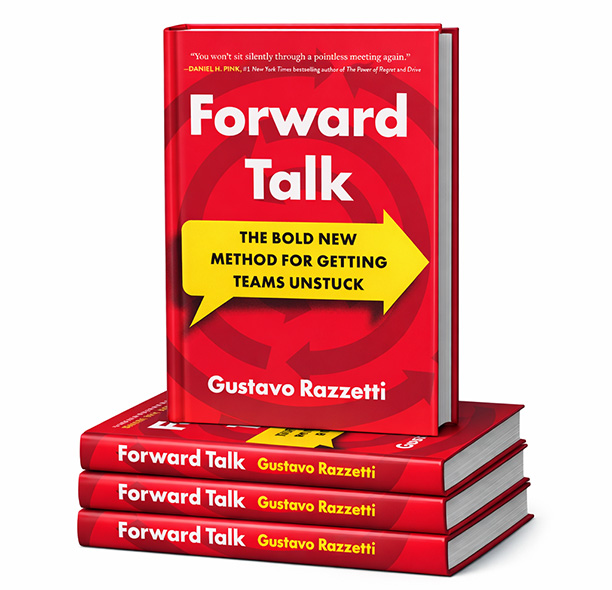 Gustavo Razzetti is a culture change instigator, speaker and CEO of Fearless Culture (www.fearlessculture.design), a culture design consultancy. His real-life insights come from leading more than 1,500 workshops with teams at Mars, Microsoft, Merck, Globant and the Inter-American Development Bank. He is the author of Forward Talk: The Bold New Method for Getting Teams Unstuck.