
Before Joseph Crivello built a private aviation company, he built the case for one. Managing flight operations for a rapidly growing commercial real estate firm gave him a front-row seat to what private aviation could deliver, and where it fell short.







In 2011, Crivello joined Phoenix Investors, which at the time held a small portfolio of retail commercial real estate. Working with his partners, the firm expanded rapidly, eventually transforming into one of the largest privately held industrial real estate portfolios in the country. Today, Phoenix Investors and its affiliates hold approximately 78 million square feet of property across 29 states.
As the company expanded, reaching facilities in tertiary markets across the country required a different approach to travel. Crivello built and managed the company’s flight operations in 2014, supporting the firm’s acquisition strategy by putting executives on the ground, often at multiple locations in a single day. “Private aviation accelerated decisions, extended our reach and gave our team time back,” he says.
While building the flight department, Crivello gained a close view of the private aviation industry. He saw the operational advantages of disciplined flight operations but also observed an industry that had grown comfortable with complexity, opacity and practices that rarely put the owner first.
In 2018, Crivello founded Jet OUT through a merger in which the Phoenix Investors flight department was spun off and combined with a separately acquired 14 CFR §135 air carrier. The goal was straightforward: keep what worked, rebuild what didn’t.
“We retained what worked: locally based aircraft, dedicated flight crews, in-house maintenance and an ‘out-and-back’ operating model,” says Crivello, who serves as the CEO and chairman. “Then we redesigned the rest to deliver a better owner experience.”
One of the defining decisions behind Jet OUT was its local-national fleet model, a co-ownership program built around regional bases where aircraft, pilots and support teams are stationed near the owners they serve. Familiarity follows. So does accountability. Owners often know their aircraft and their crews by name, creating continuity that larger, more distant operators rarely provide.
At the same time, owners need national reach. “What we set out to build was a model that gives them both,” Crivello says. Growth has required discipline to match that ambition. Every new aircraft, base or program adds layers of complexity. Staffing, maintenance, dispatch, compliance. For Crivello, scaling means ensuring every part of the operation holds its standard, not just its commercial footing.
“The biggest challenge is scaling without letting complexity creep in,” he says. To hold that standard, Jet OUT has focused on strong safety systems, a uniform fleet and regional operational teams. Safety, Crivello notes, is the baseline for operating in aviation. The harder work is building systems that allow the organization to grow without diluting what makes it reliable.
That same discipline shapes how Crivello thinks about culture. Pilots are the most visible part of any private aviation experience, but he is direct about what actually determines quality. “In aviation, everybody matters,” he says. “Owners see the pilots, but their overall experience relies equally on dispatch, maintenance, detailing, concierge services and countless others working behind the scenes.”
When crews are embedded in their communities, Crivello says, it creates the kind of continuity and local accountability that ultimately shows up in the owner experience — flight after flight.
That commitment to transparency extends to how Jet OUT prices its programs. Most private jet travel is priced by the hour. Jet OUT uses a day-based model that reflects how owners actually fly, multiple cities, their own schedule, home the same day. Pricing is published and built around operating costs. “Owners have been trained to think about travel in hourly increments, but we think it is more natural to think about what they need to get done in a day,” Crivello says. “Clarity builds trust. And trust matters in our business.”
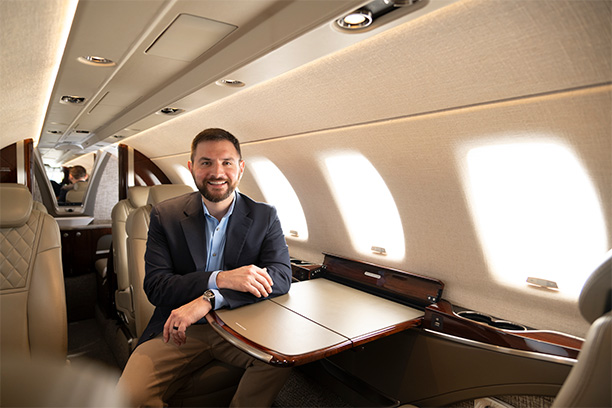
Looking ahead, Crivello describes Jet OUT’s strategy as disciplined growth: continuing to build a national network of regional bases, scaling around a consistent CJ4 Gen2 fleet, and introducing programs designed to improve the owner experience. In 2024, he also founded Co Finance, an aircraft finance company specializing in loans collateralized by co-owned aircraft. This company, which he also serves as CEO and chairman, extends the infrastructure around the ownership model itself.
“Our goal isn’t to become the biggest player in the market,” Crivello says. “It’s about building the most dependable, transparent and operationally sound platform we can, market by market.”
Jet OUT Background
- Joseph Crivello founded Jet OUT in 2018 through a merger involving the Phoenix Investors flight department and a 14 CFR §135 air carrier.
- The company operates a co-ownership private aviation program built around a local-national fleet model.
- Crivello also founded Jet IN, a fixed-base operator facility at Milwaukee Mitchell International Airport that opened in April 2023 and was acquired by Jet Aviation in September 2024.
- Crivello is a licensed commercial pilot with multi-engine and instrument ratings.
Gordon Cameron is VP of Revenue at Jet OUT.
Did You Know: The global private aviation market is projected to grow from $29.87 billion in 2025 to more than $41 billion by 2030, with the United States, responsible for roughly 65% of global private jet flights, dominating the market.