Phoenix’s industrial market continues to evolve as population growth, infrastructure investment and corporate migration reshape how companies evaluate logistics and manufacturing locations. While the market experienced a significant wave of new supply in recent years, long-term fundamentals remain strong. Tenant priorities are increasingly centered on operational efficiency, speed to occupancy and well-located facilities that support long-term business growth.





One of the most notable shifts in demand is the growing presence of manufacturing and assembly users. Earlier industrial cycles in Phoenix were largely driven by e-commerce distribution, but the region is now seeing increased activity from companies tied to semiconductor and data center supply chains. Suppliers supporting major investments by companies such as Taiwan Semiconductor Manufacturing Company and Intel are establishing operations across the metro area, creating a new layer of demand tied to advanced manufacturing and technology infrastructure.
Tenant expectations around the leasing process are also evolving. Speed to occupancy has become a critical consideration for large users entering the market. Companies want to move quickly from lease execution to full operations, which requires coordination across tenant improvement design, permitting and construction. Phoenix’s business-friendly municipal environment has helped support these timelines, with city departments working collaboratively to streamline approvals and inspections. This cooperative approach continues to reinforce Phoenix’s reputation as a preferred market for both tenants and investors.
The capital environment has also influenced development activity. After several years of robust speculative construction across the Valley, supply expanded rapidly in certain submarkets. The market is now moving through a period of absorption as tenants gradually occupy recently delivered space. While capital is beginning to re-enter the development pipeline, underwriting has become more disciplined as developers balance construction costs, lease-up timelines and land pricing.
Location remains the defining factor in determining which projects succeed. Access to major transportation corridors, proximity to labor pools and connectivity to the region’s freeway network are crucially important as the metro area continues to grow. Developers are also prioritizing sites near employee amenities and in municipalities that are actively investing in infrastructure and economic development.
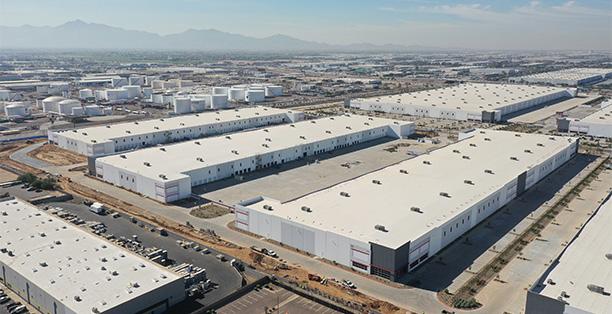
These dynamics are illustrated by developments such as CapRock West 202 Logistics, a 3.4-million-square-foot industrial campus located at the intersection of Interstate 10 and the Loop 202 South Mountain Freeway. The project was delivered in two phases across eight buildings, allowing the development team to manage risk while responding to shifting market conditions. Phase I, totaling approximately 2.5 million square feet, is now about 85% leased to tenants ranging from mid-size distributors to users occupying more than one million square feet. Phase II, comprising roughly 824,000 square feet across three buildings, was completed at the end of 2025 and is currently about 73% leased with the balance of the space being marketed for lease.
Looking ahead, several structural trends are shaping the next phase of Phoenix’s industrial growth. Power availability is now a key factor for advanced manufacturing, distribution and technology users evaluating new locations. At the same time, continued investment in transportation infrastructure, including expansion of the Valley’s freeway system, is influencing how companies assess distribution efficiency across the metro area.
Location remains paramount. While speculative development in fringe submarkets may face longer lease-up timelines, well-located industrial assets along major infrastructure corridors continue to align closely with tenant demand and long-term population growth. As land becomes increasingly constrained in core locations, more infill redevelopment opportunities may emerge, with underutilized office and call center properties potentially repositioned for industrial use in areas with strong infrastructure access and established labor pools.
As one of the fastest-growing economic centers in the U.S., Phoenix continues to lead and reward disciplined development strategies driven by careful site selection, thoughtful phasing and close coordination with local municipalities.
 Bob O’Neill is executive vice president at CapRock Partners.
Photo (West 202 Logistics) courtesy of CapRock Partners