I was 22 years old when I became mayor of Nogales, Arizona. Sitting at the edge of one of the busiest commercial land ports in the Western Hemisphere, I watched billions of dollars in trade cross the border every single day. I watched Mexico’s manufacturers supply American industries with precision and reliability. And I watched Arizona look everywhere but south for its economic future. Decades later, as I track the most consequential industrial transformation in our state’s history, I am watching it happen again.



The Ecosystem Is Already Here
Arizona is now home to the most consequential semiconductor cluster in the Western Hemisphere. TSMC has committed $165 billion to a gigafab campus in Phoenix spanning 1,100 acres, with six fabrication facilities, two advanced packaging centers, and a research and development hub planned. The first fab is already producing chips at four-nanometer precision. Amkor Technology is building a $7-billion advanced packaging and testing campus in Peoria, anchored by a formal supply chain agreement with TSMC. Intel continues its long-standing expansion in Chandler. More than 35 semiconductor companies have announced plans to expand or relocate to Arizona, drawn by the gravity of the cluster taking shape here. Specialty materials suppliers, equipment companies and chip design firms are following. Arizona State University has been selected to house two new national semiconductor development facilities expected to open by 2028. More than $200 billion in announced investment is now flowing into this state.
This is not a future story. This is happening right now. Arizona is already the center of a semiconductor ecosystem that rivals anything the United States has ever built.
Then Why Are We Looking at Asia?
Here is where I lose patience. Governors and trade delegations make headlines flying to Taiwan, Singapore, Japan and the Middle East in search of semiconductor suppliers, talent pipelines and manufacturing partners. The trips generate press. They generate photos. And they systematically overlook what is sitting in our own backyard.
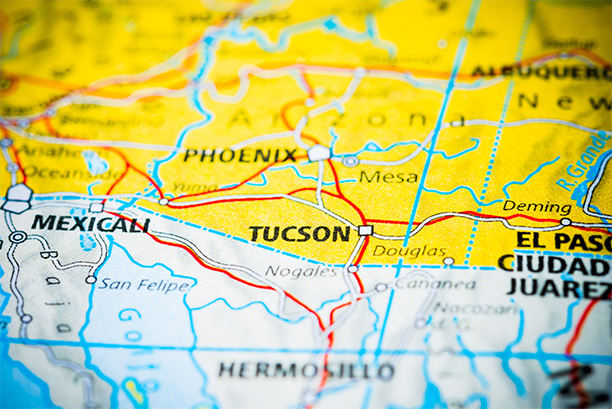
Mexico is the second-largest supplier of electronic products to the United States. More than 730 specialized electronics plants employ more than 500,000 workers across the country. Guadalajara, often called Mexico’s Silicon Valley, is home to more than 600 electronics and technology companies, with Intel, IBM and major contract manufacturers like Foxconn and Jabil operating research, design and manufacturing centers there. Chihuahua leads all Mexican states in electronics exports at $20 billion annually. Baja California follows at $19 billion, and it sits three hours from Phoenix by highway. Sonora, which shares our border, is Mexico’s dominant mining state and home to a university that has already launched a semiconductor engineering program built specifically around the talent needs of Arizona’s industry. And Mexico holds the world’s largest deposit of fluorspar, a mineral essential to the chip etching process, giving North American manufacturers a critical supply chain advantage no trip to Asia can replicate. Mexico produces more than 110,000 engineers annually. Arizona State University is already partnering with universities in Baja California, Jalisco and Monterrey to build a semiconductor talent pipeline explicitly designed for the North American supply chain.
The infrastructure, the talent, the proximity, the trade framework under USMCA and the political will are all there. What is missing is Arizona’s willingness to turn and look south with the same ambition it directs toward the other side of the planet.
Yes, Mexico Has Challenges. That Is Exactly the Point.
I hear the objections: Security concerns. Corruption. Slow economic reforms. These are real, and I do not dismiss them. I have spent my entire career navigating these realities. What I know from that experience is this: Economic investment does not wait for perfect conditions. It creates them. The single most effective force for reducing instability in any region is the arrival of genuine, sustained economic opportunity. Bringing semiconductor supply chain investment to northern Mexico does not just serve Arizona’s industrial interests. It accelerates the kind of structural change that decades of policy alone have not delivered.
The alternative, continuing to route supply chains through Asia while our neighbor goes underdeveloped, serves no one. Not Arizona businesses. Not Mexico’s workforce. Not North American supply chain security.
Arizona Needs a New Identity to Match Its New Reality
There is one more obstacle that rarely gets named honestly. Arizona still carries a perception problem. In too many boardrooms, in too many investment committees, in too many conversations in Mexico City and Monterrey and Sao Paulo, Arizona is still seen as a sun-baked western state. Not a technology powerhouse. Not a semiconductor capital. Not the obvious hub for the most important industrial corridor in the Western Hemisphere.
This is not unique to Arizona. States have successfully rebranded themselves around industry-led identity shifts before. North Carolina transformed from tobacco and textiles to Research Triangle, a globally recognized life sciences and technology hub, because its universities and companies built that story together before any government campaign caught up. Colorado remade its image around aerospace, clean energy and outdoor tech through consistent private-sector storytelling. Texas did not become a semiconductor and finance destination because of tourism ads; it happened because its business community decided that was who they were and acted accordingly.
Arizona needs that same clarity of identity. When decision-makers in Mexico, Latin America or Southeast Asia think about where to partner in North American semiconductor manufacturing, the answer needs to be Arizona, immediately and instinctively, the way Silicon Valley still triggers technology in the global imagination. That identity cannot be delegated to a government agency. It has to be led by the companies, the universities and the cross-border business community that are actually building it.
The Street Runs Both Ways
Here is what makes this a genuine tragedy of missed opportunity rather than simply an Arizona problem. Mexican cabinet secretaries and governors are making the exact same mistake in reverse. They board flights to Singapore, Frankfurt and Seoul looking for semiconductor and technology partners, chasing the headline trip and the global stage, while Phoenix sits right there, already home to the most consequential chip manufacturing cluster in the Western Hemisphere. The opportunity they are traveling 12 time zones to find is a two-hour drive from the border.
This is the same gravitational pull of the sexy overseas mission that afflicts Arizona delegations. Proximity gets mistaken for ordinariness. Distance signals ambition. But the whales are not in the ocean they are fishing. They are here, in a smaller sea that is teeming with exactly the kind of opportunity that defines the next several decades of North American economic growth.
The solution cannot be to simply wait for perception to correct itself on both sides. That has not happened in 30 years, and it will not happen on its own now.
A Call to Arizona’s CEO Community
This is where Arizona’s business leaders have a specific and urgent responsibility. The ask is not general goodwill toward Mexico. It is organized, coordinated, ongoing engagement with real investment of time and resources. Arizona’s CEOs need to take deliberate ownership of making this connection happen.
That means building the infrastructure to receive Mexican governors, federal secretaries and business delegations here in Arizona, not waiting for a trade mission to fly the other direction. Walk them through the TSMC campus in Phoenix. Show them what Amkor is building in Peoria. Sit them down with ASU leadership and the companies already anchoring this ecosystem. Make the case with evidence in front of them, consistently, over time, with the kind of follow-through that turns a visit into a partnership.
A trade mission that comes to Arizona instead of flying out of it is not just a logistical reversal. It is a statement about who Arizona is and what it has become. It is how perception changes. And it is how the most obvious partnership in North American industrial history finally gets built.
I have been watching this gap persist since I was 22 years old at the edge of that border. The opportunity has never been larger, the case has never been clearer and the cost of another decade of mutual indifference has never been higher. The answer is right here. It always has been.
This is the first of a regular, quarterly feature from Marco A. López Jr. on cross-border trade, investment and broader issues of commerce between Mexico and the State of Arizona.
 Marco A. López Jr. is founder and CEO of Intermestic Partners, a cross-border strategic advisory firm specializing in U.S.-Mexico trade, investment and border security. A former mayor of Nogales, Arizona, and chief of staff at U.S. Customs and Border Protection, he is a past member of the Council on Foreign Relations. His work focuses on strengthening regional competitiveness, trade and long-term economic growth across North America.