Sustainable growth begins when leaders stop treating differentiation as something to invent and start treating it as something to surface, validate and systematize. In most organizations, the most defensible differentiation is already there. It exists in how employees solve problems, how clients experience the company, how operations deliver under pressure and how trust is earned over time. The leader’s job is to uncover it, articulate it and turn it into a system the organization can actually deliver.






Why Most Unique Value Propositions Fail
Most unique value propositions fail for one of three reasons.
First, they are built from internal assumptions. Leaders describe what they believe makes the company valuable, but they do not fully test that belief against what clients actually need, value and experience.
Second, they sound good but are too generic. Words like “trusted,” “responsive,” “innovative” and “customer-focused” may be true, but competitors can often say the same thing. If the language does not connect specific client pain points to specific organizational strengths, it will not create meaningful differentiation.
Third, the organization cannot consistently deliver what the value proposition promises. A strong UVP is not a marketing line. It is an operating commitment. If sales says one thing, operations delivers another, and employees interpret the message differently, the value proposition becomes fragile.
A UVP works only when it is believable, provable and repeatable.
How Leaders Can Surface Differentiation in 90 Days
The good news is that leaders do not need a yearlong transformation to begin. In 90 days, they can create meaningful clarity by using a disciplined discovery process.
Start internally. Interview employees across functions, levels and tenure. Ask what the organization does especially well, where clients experience the most value, what problems the team solves better than others and what capabilities are often overlooked. This surfaces the truth inside the business, including strengths leadership may not fully see.
Then validate externally. Talk with clients about their pain points, success factors, decision criteria and experience working with the organization. The goal is not to ask clients to write the company’s value proposition. The goal is to understand what they truly value, then connect those needs to what the company can consistently deliver.
Finally, synthesize the findings. Separate “like” competencies from truly differentiated strengths. Like competencies are important capabilities an organization may share with competitors. Differentiated strengths are the areas where one organization creates value in a way that is harder to copy. When both are understood clearly, leaders can build a UVP that is honest, relevant and defensible.
Growth without Heroics
Once the value proposition is clear, the work shifts from insight to execution. This is where scalable growth is created.
A validated UVP should become a practical system: messaging, sales tools, client proof, training, onboarding and operational alignment. It should help a new salesperson explain the business with confidence. It should help an operator participate in a client conversation with credibility. It should help marketing tell a consistent story and help leadership make better decisions about where to focus.
This reduces reliance on heroic individual performance. Top performers become more efficient because they no longer have to reinvent the story in every opportunity. Less experienced employees become effective faster because they have a clear framework to follow. Client-facing employees outside of sales become part of the growth engine because they understand the value they help deliver.
That is growth without heroics: not eliminating high performers but building a system that makes the whole organization stronger.
The most defensible differentiation is rarely a slogan. It is the lived truth of the organization, validated by clients and translated into repeatable action.
When leaders surface that truth, build a UVP the organization can deliver and equip people across the company to use it consistently, growth becomes more predictable, more credible and more scalable.
And if a star performer leaves, the organization does not lose its voice. It already knows who it is, why clients choose it and how to deliver that value again and again.
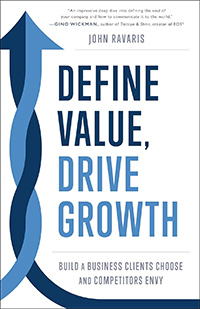
John Ravaris is a business strategist and the founder of UVPsolutions, where he helps organizations clarify their unique value and translate it into measurable growth. He is the author of Define Value, Drive Growth (released June 2, 2026), a practical guide to aligning strategy, messaging and execution to unlock competitive advantage. With a focus on helping leaders articulate what truly differentiates their business, Ravaris works with companies to drive stronger market positioning and sustainable results.