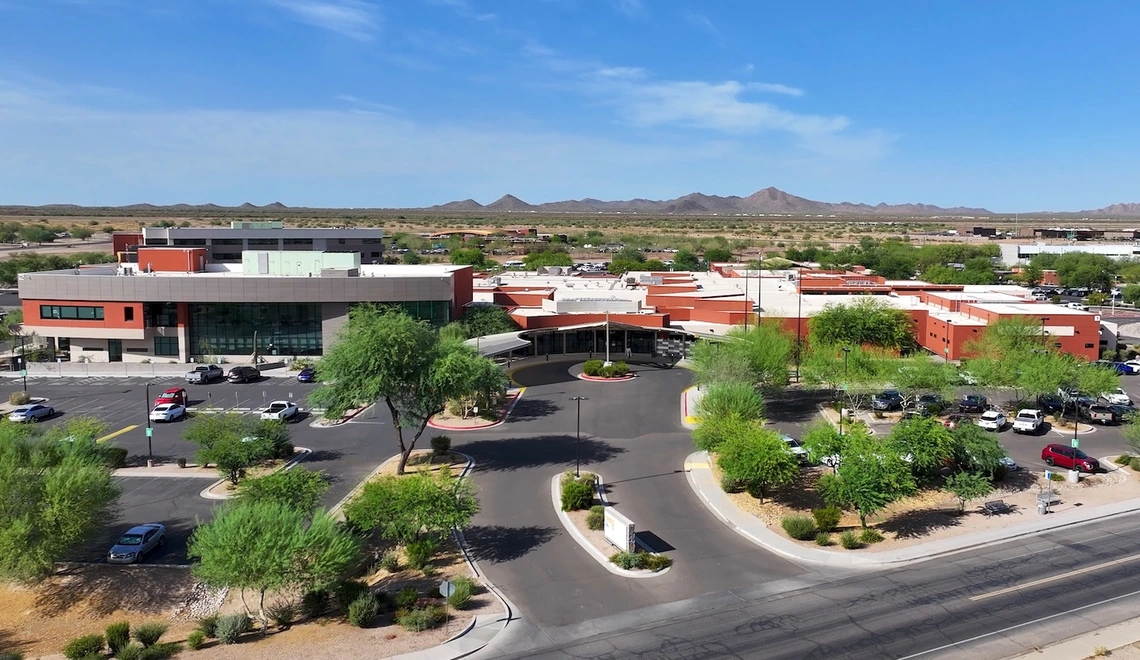
The University of Arizona and Gila River Health Care, the Gila River Indian Community’s tribally operated healthcare system, announced a long-term partnership to establish the nation’s first MD-granting medical school branch located on the lands of a sovereign Tribal Nation.







The University of Arizona College of Medicine – Phoenix Regional Medical Branch in Sacaton, Arizona, is designed to educate future physicians within a Tribal healthcare system while strengthening access to care in Tribal, rural and medically underserved communities. Beginning in July 2027, ten students will be admitted annually to the University of Arizona College of Medicine – Phoenix’s three-year MD-granting Primary Care Accelerated Program at the Gila River Branch. Students will receive full tuition scholarships funded by GRHC. They will complete the first 18 months of their foundational medical education in Phoenix before relocating to Sacaton for the final 18 months of clinical education.
“Tribal and rural communities have some of the nation’s greatest unmet primary care needs,” University of Arizona President Suresh Garimella said. “This partnership to establish the country’s first medical school branch within a Tribal Nation will train physicians through an accelerated three-year MD program, support them with full scholarships to free them of debt burden and provide residency opportunities that anchor them to the places and patients they know. That is how you build a physician workforce that remains in the communities that need them most.”
The U.S. continues to face persistent physician shortages, particularly in rural and Tribal communities. Arizona ranks No. 42 in the nation for primary care access, and its rapidly growing population has intensified the demand for primary care physicians. Research shows that physicians are more likely to practice where they train, making community-based medical education a proven strategy for strengthening Arizona’s long-term healthcare workforce.
Rather than expanding medical education solely through large academic medical centers, the Regional Medical Branch places students within a community-based healthcare system, where they will learn by caring for patients and working alongside physicians serving Native communities every day. Under exploration is the development of primary care residency programs at GRHC, which will further strengthen the long-term goal of retaining physicians to serve the Community and other underserved areas.
“This is a tremendous opportunity for our community and for the next generation of physicians,” said Stephen Roe Lewis, Governor of the Gila River Indian Community. “For too long, many of our young people who dreamed of becoming doctors had to leave home to pursue that goal. This partnership with the University of Arizona changes that. It gives them the opportunity to learn, train and build their careers right here in the Community, where they can make a real difference for the people they serve.”
GRHC has committed more than $25 million through 2034 to establish and support the Regional Medical Branch, including faculty positions, student scholarships and educational infrastructure. Unlike traditional clinical rotations, students will become part of a healthcare system. Working under faculty supervision, they will care for patients across a broad range of clinical settings while gaining firsthand understanding of the historical, cultural, and social factors that influence health. University and GRHC leaders also believe the partnership will inspire more Native American students to pursue medicine while strengthening long-term pathways into Arizona’s physician workforce.
“This partnership challenges us to think differently about where and how physicians are educated,” said Dr. Fredric Wondisford, dean of the University of Arizona College of Medicine – Phoenix. “Clinical excellence is shaped not only by scientific knowledge, but by understanding the communities physicians serve. By educating future physicians within a tribally operated healthcare system serving Native communities, we are creating a learning experience that cannot be replicated in a traditional academic medical center.”
Developed through close collaboration between the U of A and GRHC, the partnership reflects shared leadership, mutual respect and a long-term commitment to improving health outcomes when training the next generation of physicians. It demonstrates how public research universities, sovereign Tribal Nations and community healthcare systems can work together to strengthen the physician workforce while improving access to care. The partnership also reinforces the U of A’s long-term investment in preparing physicians to serve communities across the state.
“There’s a real challenge for rural health hospitals to recruit trained professionals to come and work in their communities,” said Robert Pablo, chairman of the Gila River Health Care Board of Directors. “We are very fortunate to launch this first-of-its-kind partnership between Gila River Health Care and the University of Arizona, which will establish a starting ground for these young doctors to jumpstart their careers.”
Inspired by a similar partnership announced last year with Onvida Health in Yuma, the Regional Medical Branch further advances the University of Arizona’s commitment to expanding community-based medical education across Arizona. The Association of American Medical Colleges projects the United States could face a shortage of up to 86,000 physicians by 2036, with Tribal and rural communities expected to be among those most affected.
Leaders from the U of A, Gila River Indian Community and GRHC believe the future of medical education will increasingly be shaped by partnerships that connect land-grant universities more deeply with the communities they are called to serve. They are confident that this first-of-its-kind collaboration demonstrates how public research universities, sovereign Tribal Nations and community healthcare systems can work together to strengthen the physician workforce, improve access to care and expand educational opportunity for generations to come.