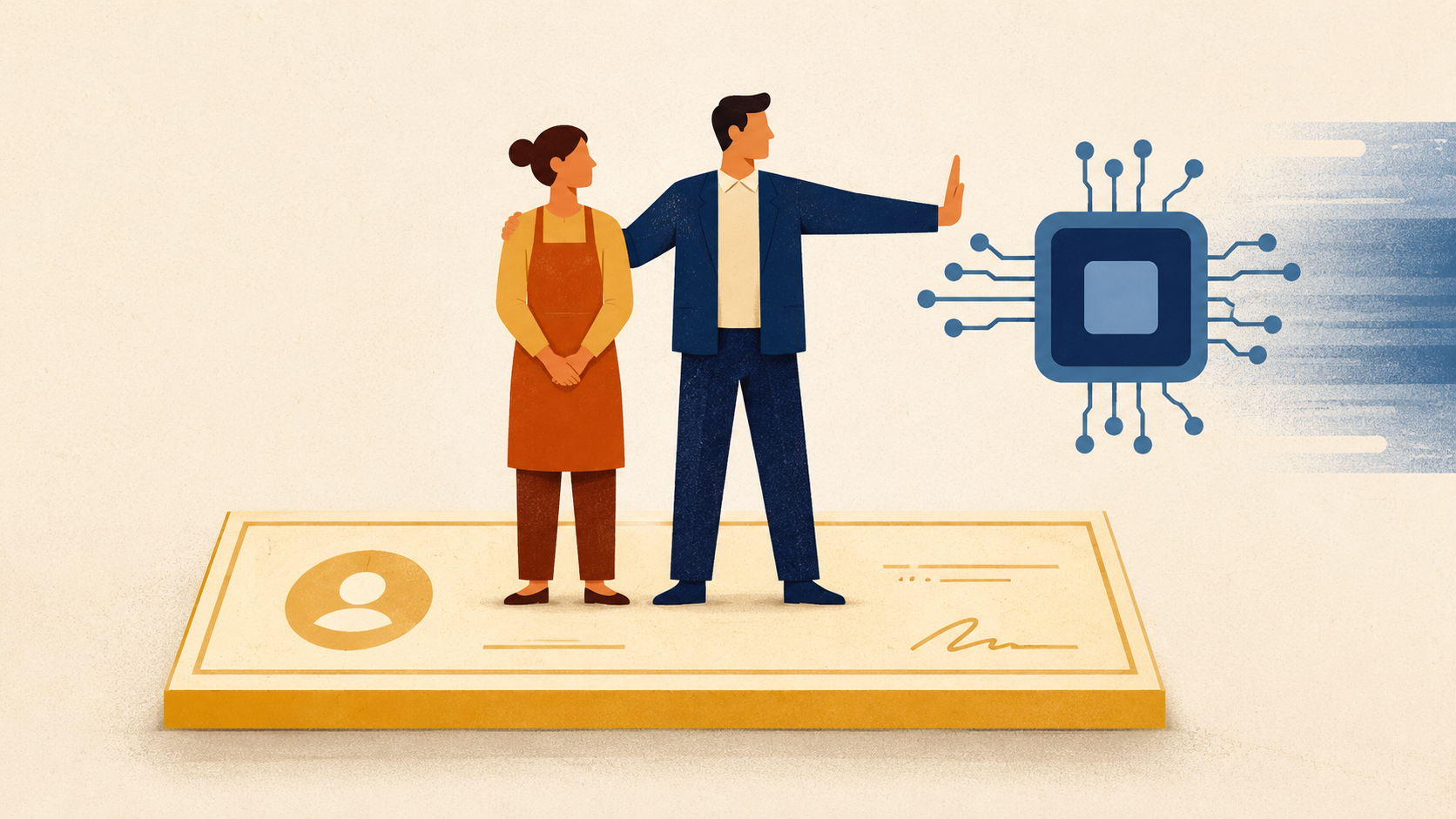
AI may promise lower costs, faster output and leaner teams, but small-business owners are not rushing to replace trusted employees with software.






A new study of 3,022 small-business owners by Careerminds, a global workforce solutions provider, found that 67% believe AI could already perform a meaningful portion of the work handled by at least one employee. Applied to estimated small-business employment in Arizona, the state-level findings suggest approximately 937,091 employees hold roles in which owners believe AI could perform part of the job.
Many of those employees are being retained not because automation is impossible, but because their employers feel loyal to them. One-third of owners said loyalty would be the primary reason they would not replace an employee with AI. Another 17% cited the employee’s long service, while 13% said the person’s knowledge of the business would be difficult to replace. Owners also pointed to customer relationships and a personal responsibility for employees’ financial well-being.
Together, those decisions form what might be called the “loyalty payroll”: the financial cost small businesses are willing to absorb to protect the people who helped build them. Unlike decisions at large companies, which may be made several layers above the employees affected, small-business owners often work only a few feet from the person whose job is under consideration. That personal connection appears to matter.
How long would small-business owners keep paying the loyalty payroll?
Owners were divided over how long they would retain an employee if AI could perform most of that person’s work more cheaply. Nearly one-quarter, 24%, would continue employing the person for six to 12 months; 18% said less than six months; and another 18% said one to two years.
At the more protective end of the scale, 23% would retain the employee for as long as the business could afford it, while 10% would keep the person indefinitely. Combined, one-third of owners would keep an employee indefinitely or until the financial burden became unsustainable.
That does not mean every owner is currently sacrificing profits. It does, however, suggest that many are willing to absorb some additional cost before replacing a person with technology.
Small-business owners are already delaying AI to protect employees
The tension between efficiency and responsibility is not merely hypothetical. Sixty-one percent of owners said they have delayed introducing AI because of concerns about its effects on employees, while 59% have rejected a particular AI tool specifically because it could result in job losses.
Owners were most reluctant to replace:
- Long-tenured employees: 28%
- Employees approaching retirement: 22%
- Employees with families or dependents: 20%
- Employees who helped build the business: 15%
- Employees with strong customer relationships: 9%
- Employees with specialized company knowledge: 6%
The findings suggest that personal circumstances can carry almost as much weight as business performance. An employee approaching retirement may be protected because finding another job could be difficult, while one with children may inspire a stronger sense of responsibility. Someone who joined during the company’s early years may be viewed less as an employee and more as part of its story.
Small-business owners feel more personally responsible
Three-quarters of respondents believe they have a greater personal responsibility toward employees than larger companies do when making decisions about AI. A corporation may describe job cuts as a restructuring exercise; a small-business owner may have to deliver the news personally to someone they have worked beside for years.
When asked which statement most closely reflected their views, 47% said employers should protect jobs wherever reasonably possible and 31% said jobs should be protected even if doing so reduces profits. By comparison, 15% said the survival of the business should take priority, while just 7% believed employers should adopt AI whenever it is financially beneficial.
Fewer employees still appear inevitable
Loyalty may slow automation’s effects, but most owners do not believe it will stop them. Fifty-six percent expect their businesses to employ fewer people because of AI within the next three years.
That shift may happen gradually rather than through immediate layoffs. An owner may be unwilling to dismiss a trusted employee but choose not to fill the position after that person resigns or retires. The employee remains secure while the role quietly disappears.
Many employers have already begun preparing their teams for that possibility. Sixty-two percent said they have spoken openly with employees about how AI could affect their roles. Those conversations are likely to become more common as owners balance two competing obligations: keeping their businesses financially viable and treating their employees fairly.
“Small-business owners often have a much more personal relationship with their employees. They know the people behind every paycheck, and they understand what losing a job could mean for someone who may have worked alongside them for years. That makes the decision to automate a role much more complicated than simply comparing the cost of an employee with the cost of a software subscription,” said Amanda Augustine, Certified Professional Career Coach and resident career expert for Careerminds.
“But loyalty can only delay these decisions for so long. If AI can take over a meaningful portion of someone’s job, the better question is how that role needs to evolve and where that employee can continue to add value. Rather than waiting until the economics force their hand, small-business owners can use this time to identify opportunities to reskill employees, shift responsibilities, and help people develop the skills they’ll need to work alongside AI. Protecting employees doesn’t have to mean protecting every job exactly as it exists today.”