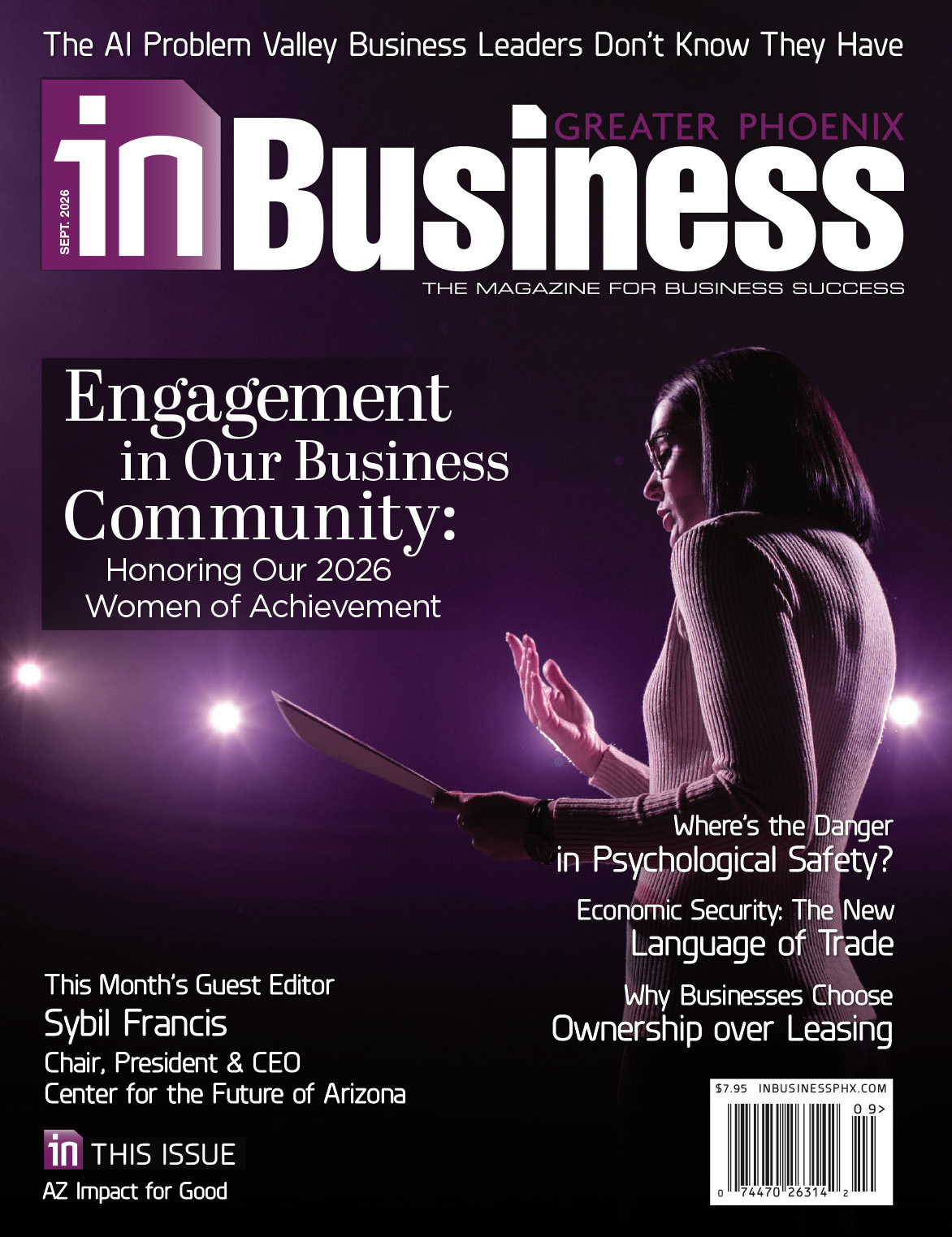
Greater Phoenix is building a technology economy that needs both automation and a deeper talent bench. In Business Magazine’s August issue puts young workers, AI accountability and the semiconductor workforce in the same conversation. Arizona is also expanding a registered-apprenticeship system that now reaches modern sectors, including semiconductors, cybersecurity, healthcare and IT.







Employers should connect those two agendas.
Stanford’s updated payroll analysis finds that employment among U.S. workers ages 22–25 in highly AI-exposed occupations is about 19% below where it would be if it had kept pace with similarly aged workers in less-exposed occupations. The comparable gap was 15% in the July 2025 data vintage. The adjustment appears mainly through reduced hiring, while experienced workers show no comparable gap.
Arizona employers do not need to choose between AI efficiency and early-career development. What they need is an apprenticeship scorecard for AI-enabled work.
For every workflow changed by AI, track four numbers: hours of routine preparation automated, hours of experienced-worker coaching created, number of junior employees handling verification and exceptions, and median time until a junior can own a representative decision independently.
A common accounting mistake is to count the time saved by AI without accounting for the judgment-building work that disappears when junior employees no longer practice recognizing a bad assumption, recovering from an exception or explaining a tradeoff to a customer.
Arizona’s ReadyTechGo expansion is built around stackable skills and hands-on training for advanced manufacturing. Employers should carry that same logic into white-collar and technical AI workflows.
Let AI prepare the first draft. Let junior workers test it, challenge it and make supervised recommendations. Let experienced employees spend less time on routine production and more time transferring judgment.
The strongest AI strategy is one that produces more capable people per year, not simply fewer labor hours per task.
 Gleb Tsipursky, Ph.D., is a behavioral scientist, CEO of Disaster Avoidance Experts and author of The Psychology of AI Adoption at Work: From Resistance to Results (Georgetown University Press, 2026).