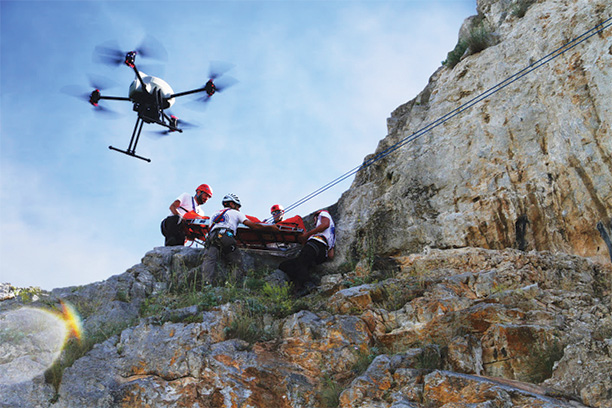
When a police commander can see an unfolding scene before officers arrive, or a utility executive can detect infrastructure stress before failure, the advantage is not the drone. It is the decision. Phoenix-based Rapid Drone has built its business around that distinction.






As organizations face pressure to move faster, operate leaner and reduce risk, Rapid Drone does not sell aircraft. It sells operational clarity. The company designs and manages end-to-end drone programs for public safety agencies and asset-heavy industries that need consistent aerial intelligence without building internal aviation departments.
The global commercial drone market is projected to grow from roughly $30 billion in 2024 to more than $54 billion by 2030. But the story is less about hardware and more about integration. Compliance standards, cybersecurity protocols, pilot certification and data management have made scaling programs more complex than many anticipated.
Rapid Drone removes that friction. The company operates USA Blue Certified aircraft and oversees flight operations, data capture, analysis and secure integration into client systems. Rather than delivering equipment, it provides a managed intelligence layer embedded into existing workflows.
“Better information changes outcomes,” says David Rietz, chief drone officer at Rapid Drone. “For organizations operating in high-stakes environments, access to timely, accurate aerial intelligence can mean safer personnel, reduced downtime and better decisions.”
In public safety, that shift is evident in Drones as First Responders programs, where unmanned aircraft deploy to incident scenes and stream live video to command staff before units arrive. What once required a helicopter or delayed reports can now be accessed in moments.
In utilities and infrastructure, continuous aerial visibility helps teams identify issues early and prioritize maintenance before disruptions occur. In construction and AEC, aerial mapping supports smarter planning and clearer documentation throughout a project’s lifecycle. Thermal imaging can flag anomalies in bridges, pipelines and power systems before they become costly failures. In agriculture, advanced imaging reveals crop stress patterns invisible from the ground, allowing more precise irrigation and treatment decisions.
The technology itself is not new. What has changed is the expectation that aerial intelligence be continuous, integrated and decision-ready. Early adoption centered on one-time inspections or surveys. Increasingly, organizations are embedding aerial data into compliance reporting, maintenance scheduling, capital planning and risk mitigation strategies.
“Agencies and enterprises are being asked to do more with fewer resources while expectations for safety, accountability and speed continue to rise,” says co-founder Debbie Steinhauer. “Our focus is on making advanced aerial intelligence practical to deploy, easy to integrate and dependable in real-world operations.”
Rapid Drone’s leadership team brings experience spanning more than $2 billion in real estate development, national public safety leadership and decades of UAV engineering. An advisory board of law enforcement and retired military leaders reinforces the company’s emphasis on disciplined program management and regulatory rigor.
As scrutiny around data security and public-sector accountability intensifies, oversight has become part of the value proposition. For many executives, the question is no longer whether drones are useful. It is whether aerial intelligence can scale responsibly without disrupting core operations.
Rapid Drone is expanding Drones as First Responders programs and scaling remote operations nationwide across infrastructure, agriculture and AEC. The broader goal is to move aerial intelligence from a supplemental tool to a standard operational layer.
In a business environment defined by compressed timelines and heightened accountability, visibility is no longer a luxury. It is infrastructure. For organizations managing complex physical assets, the advantage lies in translating what they see into informed action.
Photo courtesy of Rapid Drone