From capital allocation to AI adoption, thoughtful leaders are finding that measured decisions outperform reactive ones.







In business, speed signals confidence. Leaders respond to emails within minutes, approve deals in real time and implement new technology before competitors schedule a demo. Fast action projects authority.
But in 2026, as Arizona companies navigate AI acceleration, economic uncertainty and workforce fatigue, speed alone is no longer a competitive advantage. Increasingly, performance depends on something less visible and more disciplined: the ability to pause.
Dr. Emilio Justo, a Phoenix-based ophthalmologist, cosmetic surgeon and founder of Arizona Eye Institute & Cosmetic Laser Center, argues that strategic restraint separates reactive organizations from durable ones. In his book, The Power of Pause: Mastering Delayed Gratification for Success, he reframes patience not as a personality trait but as a leadership competency that improves judgment, reduces volatility and strengthens long-term results.
“The pause isn’t about hesitation,” Justo says. “It’s about alignment.”
For executives responsible for growth, capital allocation and culture, that distinction carries operational weight.
The Five-Second Discipline
In the operating room, Justo practices what he teaches.
Before the first incision, there is a moment of stillness. Not uncertainty. A deliberate internal review. He asks three silent questions: Is this necessary? Is this the right timing? Is this the right approach?
That filter carries into business decisions: When a partnership proposal lands on his desk. When an email provokes emotion. When a meeting turns urgent.
“I often physically lean back in my chair,” he says. “That posture shift signals to my brain that I’m moving from reaction to strategy.”
The pause lasts five to 15 seconds. Neurologically, it is significant.
Rapid reactions originate in the limbic system, the brain’s emotional center designed for survival. It prioritizes speed over nuance. A pause allows the prefrontal cortex, responsible for executive function and long-term planning, to reengage.
Stress hormones decrease. Cognitive clarity improves. Impulse gives way to evaluation.
In medicine, that shift protects outcomes. In business, it protects strategy.
A Defining Career Choice
Justo’s philosophy is not theoretical. Early in his career, he faced a pivotal decision. Large ophthalmology groups were expanding across Arizona. Joining one offered stability, brand recognition and predictable income.
It was the logical choice. Many peers accepted similar offers.
He paused.
Instead of asking what felt safest, he reframed the decision: “What choice aligns with who I want to become 20 years from now?”
The answer led him to build his own private practice from the ground up.
The path involved financial risk and long hours. It also offered autonomy over hiring, standards and expansion. He could shape culture intentionally rather than adapt to one already in place.
“That pause wasn’t about hesitation,” he says. “It was about identity.”
Arizona Eye Institute & Cosmetic Laser Center grew under that long-term orientation. Justo expanded into cosmetic laser surgery and developed leadership systems that integrated entrepreneurship with medicine.
Identity-driven decisions compound differently from fear-driven ones. One builds ownership and resilience. The other builds dependency.
For Arizona founders weighing mergers, capital raises or early exits, the lesson is practical. Short-term security can conflict with long-term vision. The pause creates space to choose deliberately.
Delay vs. Discipline
In fast-moving industries, pausing can feel risky. Leaders worry it signals indecision. Instant responses appear decisive. Immediate answers suggest command.
Justo draws a clear distinction between delay and discipline.
“High-level leaders don’t respond instantly,” he says. “They respond intentionally.”
Rather than react on the spot, he establishes a timeline: “Let me think this through and get back to you tomorrow.”
That approach signals control. It sets expectations. It preserves authority.
Momentum is not speed. It is direction. A well-considered decision delivered slightly later often carries more weight than a rushed response given immediately.
Teams rarely lose confidence in thoughtful leaders. They lose confidence in inconsistency.
Across Arizona’s healthcare, commercial real estate, finance and technology sectors, consistency builds trust faster than velocity.
The 2026 Pressure Point
Technological acceleration defines the executive agenda in 2026. Artificial intelligence tools promise efficiency. Automation compresses timelines. Digital communication eliminates natural pauses.
Boards expect innovation. Competitors adopt new platforms. Employees demand modernization.
The pressure to move quickly is constant.
Justo cautions against equating adoption with advantage.
“Leadership now requires discernment more than velocity,” he says.
Adopting every emerging tool may create short-term momentum but undermine operational cohesion. Reacting to market fluctuations can erode strategic focus. Restructuring in response to quarterly noise destabilizes culture.
The organizations that endure will not be the fastest adopters. They will be the most thoughtful integrators.
That requires leaders who slow their thinking without slowing execution. The distinction is subtle but consequential.
The Entrepreneur’s Urgency Trap
Early-stage companies feel this tension acutely. Limited capital and lean teams reward decisiveness. Speed can mean survival.
Yet urgency also increases the risk of reactive decisions, including premature hiring, overexpansion and poorly timed capital deployment.
Drawing from his experience building a medical practice, Justo argues that sustainable growth depends on leaders who tolerate uncertainty and resist short-term wins that compromise long-term stability.
Pausing before signing a lease, adding headcount or entering a partnership allows for clearer evaluation of timing, culture fit and financial durability.
Decision fatigue accelerates in environments that reward constant responsiveness. Over time, that reactivity erodes executive bandwidth and organizational morale.
A disciplined pause interrupts that cycle. It strengthens judgment and signals steadiness to the broader team.
The result is not slower companies. It is more durable ones.
The Organizational Ripple Effect
The impact of pausing extends beyond individual decisions.
When leaders model thoughtful responses, teams mirror it. Meetings become more focused. Communication becomes clearer. Emotional volatility decreases.
That steadiness strengthens trust and alignment.
By contrast, leaders who operate in constant reaction mode create instability. Employees adjust defensively. Turnover increases. Strategic clarity suffers.
In industries facing workforce shortages and burnout, including healthcare and technology across Arizona, cultural stability has become a competitive asset.
A disciplined pause signals that decisions are evaluated rather than improvised.
The Undervalued Advantage
In a culture that rewards immediacy, patience rarely appears on performance metrics. Yet its absence is visible in postmortems.
Misaligned acquisitions. Fractured cultures after rushed restructures. Technology rollouts that outpace training. Many trace back to decisions made under pressure without sufficient reflection.
Justo’s message is not about slowing down for its own sake. It is about ensuring that action aligns with intention. “The ability to wait strategically may be the most undervalued competitive advantage of all,” he says.
For Arizona executives steering organizations through rapid change, the takeaway is direct. Speed amplifies direction. If direction is flawed, speed compounds the error.
Five seconds of discipline can recalibrate trajectory. In business, as in surgery, the moment before action often determines the outcome.
 After emigrating to the U.S. at age 3 and completing the University of Michigan’s rigorous medical program at 23, Emilio Justo, M.D., started the Arizona Eye Institute & Cosmetic Laser Center in 1989 at age 27 and has continued to expand into new and exciting fields of cosmetic surgery. Dr. Justo first trained as an ophthalmologist but then mastered techniques as a plastic surgeon, quickly becoming the Phoenix area’s premier cosmetic and ocular surgeon, with facilities in both Sun City West, Sun City and Wickenburg.
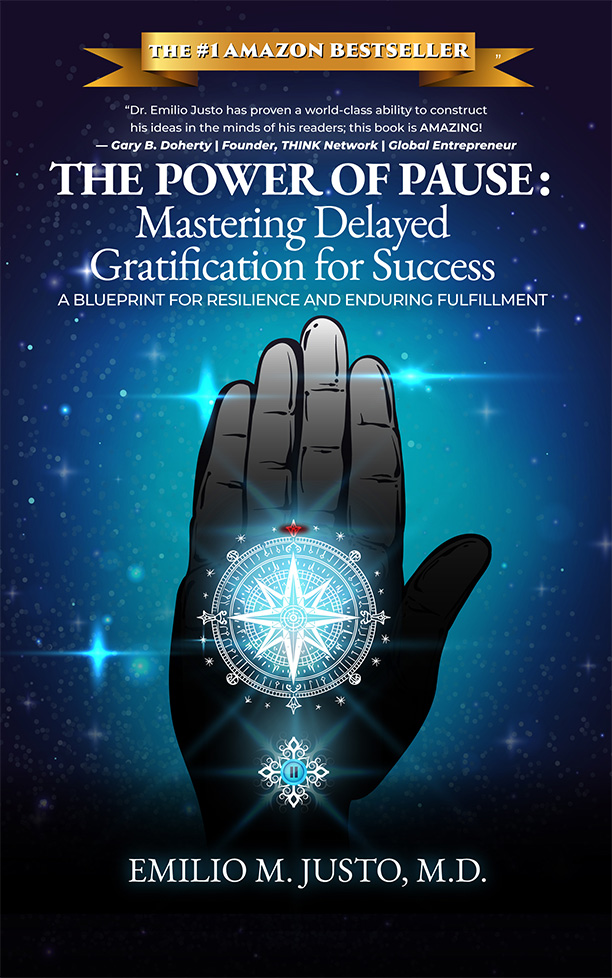
In “The Power of Pause,” Dr. Justo explores the principles of resilience, patience and finding purpose in life’s journey. More than a personal story, it invites readers to embrace each challenge as an opportunity for growth.