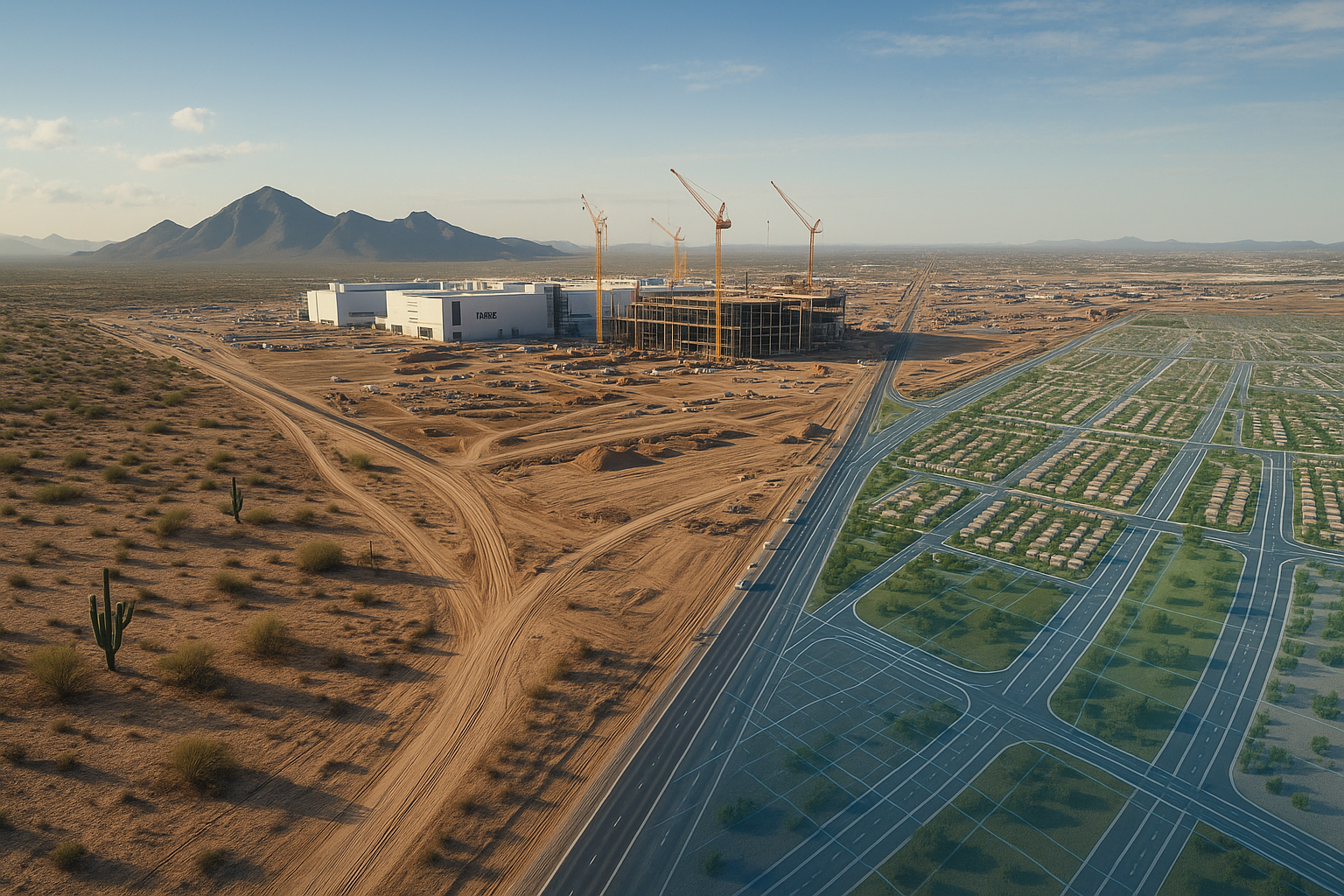
 The region surrounding Taiwan Semiconductor Manufacturing Company’s fabrication complex in north Phoenix has emerged as one of Arizona’s most significant zones for planned development. Anchored by the ongoing expansion of TSMC’s chip production capacity, the area is slated to evolve into a fully integrated live-work region, featuring large-scale residential districts, commercial amenities, supplier parks and crucial infrastructure. This transformation is being guided by public-private cooperation, master-planning efforts and state-level land initiatives. What looks like little more than desert today will soon be a thriving city within a city.
The Backbone: TSMC’s Expanding Semiconductor Campus






TSMC’s Arizona operations already represent one of the largest foreign direct investments in U.S. manufacturing. Initially launched with a commitment of roughly $12 billion in 2020, the company has since increased its U.S. investment target to $165 billion, including three additional fabs, two advanced packaging facilities and a dedicated research and development center.
The company broke ground on its third fab near 43rd Avenue and Dove Valley Road in April 2025, projecting production of 2-nanometer (or more advanced) process nodes and the creation of roughly 6,000 high-skilled manufacturing jobs. TSMC’s executives and local partners increasingly refer to its Phoenix site as a future “gigafab cluster,” signaling plans for further scaling beyond its initial three fabs.
Because advanced semiconductor manufacturing demands highly reliable utilities, water reuse and logistics support, TSMC has made a move to begin construction of a 15-acre industrial water reclamation plant to recycle process water at high efficiency — targeting operation by 2028 — in response to regional hydrological constraints.
Master Planning for Mixed Use: Halo Vista and Surrounding Proposals
The most ambitious plan to date is Halo Vista, a $7-billion mixed-use development envisioned around 2,300 acres encircling the TSMC site. Mack Real Estate Group and McCourt Partners secured land development rights through a state auction, positioning Halo Vista as a “halo” of supporting activity around the chip campus.
Halo Vista is visioned as more than a conventional industrial park. It includes:
- Approximately 12 million square feet of industrial and manufacturing space (termed “The Forge”)
- A 3.5-million square foot Sonoran Oasis Research & Technology Park
- Almost 9,000 residential units
- Retail, hotel, office and institutional spaces
- When fully developed, it is projected to support as many as 62,000 jobs in varying sectors.
Beyond Halo Vista, other master-planning proposals are under consideration. One such plan calls for six “master development parcels” with a cap of 19,247 dwelling units, while adjacent parcels would accommodate mixed-use, higher-density housing; medical facilities; hospitality; and neighborhood village components.
Simultaneously, the NorthPark project — a 6,000-acre master planned community on state trust land south of the TSMC campus — has gained momentum. PulteGroup has spearheaded rezoning efforts, and TSMC recently aligned as a partner in those efforts, signaling an integrated vision linking TSMC’s workforce demand to residential supply.
On a smaller scale, the Verdin development by Taylor Morrison is underway about several miles south of the campus. Spanning more than 472 acres, Verdin proposes more than 1,225 single-family homes, multiple floor plans, preserved natural areas and trail connectivity.
In the nearer term, build-to-rent multifamily projects will also be popping up. Examples include a 297-unit “Inspire Sonoran Desert” development, a 436-unit mid-rise by Toll Brothers, and other rental communities designed to support the immediate housing pressure from the expanding workforce.
Commercial, Hospitality and Supplier Ecosystem
A 112-acre commercial center — Dove Valley Towne Center — is proposed near the campus, embedding large-format retail and multiple hotels intended to serve visitors, business travelers and training cohorts. (Earlier reporting has flagged this development, although site plans remain under review.)
Industrial parks and flex facilities are being positioned strategically along the major corridors of I-17 and Loop 303 to host semiconductor suppliers, logistics providers and service firms seeking proximity. The Deer Valley 30 industrial park is an early example marketed as a prime location for TSMC-adjacent manufacturing.
These commercial and industrial developments aim to complete the live, work, play ecosystem. Because of the scale, development will unfold in phases across decades. Analysts estimate the full horizon for build-out may exceed 20 years.
Significant infrastructure upgrades are already anticipated. ADOT has begun work on improvements to the I-17 / Loop 303 interchange to relieve projected congestion. Utility providers are engineering power, water and wastewater expansion. Simultaneously, TSMC’s strategy for near-zero liquid discharge and aggressive water recycling is intended to align with Arizona’s long-term water constraints.
Outlook and Implications
The coming together of semiconductor manufacturing and urban planning in north Phoenix presents a rare opportunity — to establish a technology-centered community at scale. If development proceeds as projected, the zone surrounding TSMC’s campus may evolve into a model of integrated industrial and civic planning: housing, commerce, research and manufacturing.
Challenges remain. Transportation infrastructure, water supply, school capacity and environmental mitigation will need careful management. Market timing, macroeconomic conditions and supply chain dynamics could influence the pace of completion.
Yet the trajectory is clear: The region is poised for one of Arizona’s most transformative development chapters. With TSMC as anchor, Halo Vista, NorthPark, Verdin and associated projects may together shape a new, dense, innovation-oriented corridor in the desert that transcends simple industrial adjacency; it aims to become a thriving, sustainable live-work community.
 Kim Ryder is a dynamic commercial real estate executive with extensive experience in managing multi-million-dollar, complex projects and the build-out of more than 54 million square feet of retail and commercial space. Ryder has started several business lines in her career, most notably launching Thrive Real Estate and Development groups. Her career in the thrift industry extends over 25 years and led her team to expand the Goodwill real estate portfolio by more than 100 locations, having leadership over more than 400 transactions. Her expertise in thrift real estate has made her a well-known resource of knowledge.