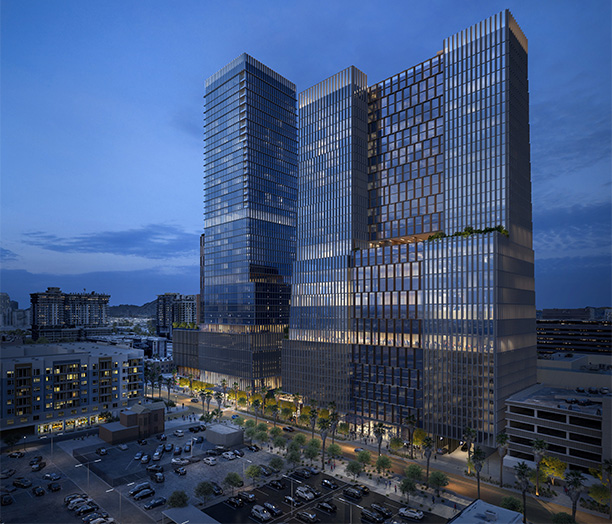
Arro, courtesy of The Empire Group of Companies
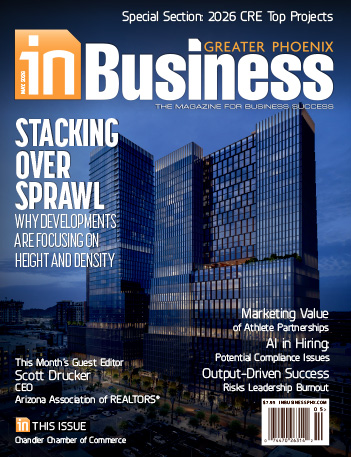
Yesterday’s emphasis on wide-open spaces, large lots and suburban living has been replaced by density with a focus on walkability. Residential units are a big part of today’s commercial development projects, with retail, office, entertainment and service built into the plan.






Yes, Metro Phoenix is still seeing plenty of development at its outer boundaries as its business and population growth continues to lead the country, but infill and redevelopment are expanding the economic vitality in already developed neighborhoods as demographics support more vertical mixed-use, or “stacking.”
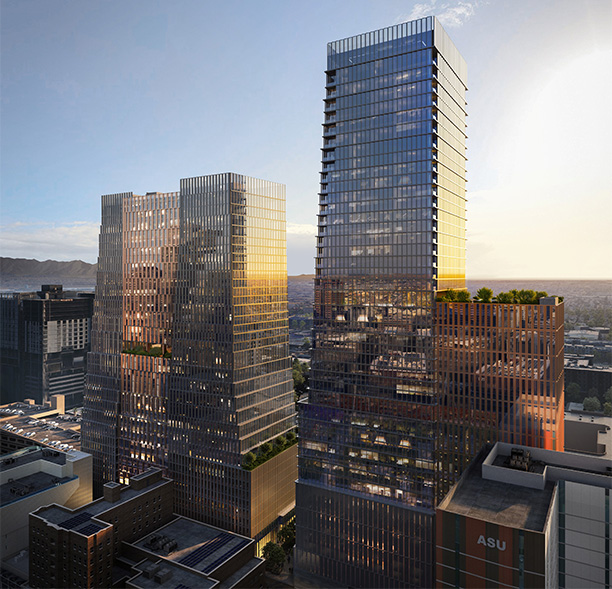
Arro, courtesy of The Empire Group of Companies
Arro
In the vertical development space, the top spot goes to Arro, developed by Empire Group of Companies through its luxury urban infill division Aspirant Development. Aiming to be a standout in the downtown skyline, its 541-foot-tall north tower is set to become the tallest building not just in the City of Phoenix but in the State of Arizona when it’s completed in three to four years.
This tower plus the project’s 425-foot-tall south tower will add to Downtown’s residential component with 380 Class A+ units in the north tower and 275 luxury co-living units in the south tower, plus a 250-key luxury lifestyle hotel in the north tower. Noting the project will include retail and restaurant space at ground floor and within the towers, office, underground parking and entertainment offerings, Geoffrey Jacobs, managing partner of Aspirant and a principal of Empire, says, “Providing amenities like retail, restaurant and office for residents where density is increasing is key.”
The trend toward density combines with changing demographics, with both impacting development. “Demographics of downtown markets skew younger and convenience is paramount,” Jacobs says. “Services and amenities are in high demand and what residents of luxury high-rises want today.”
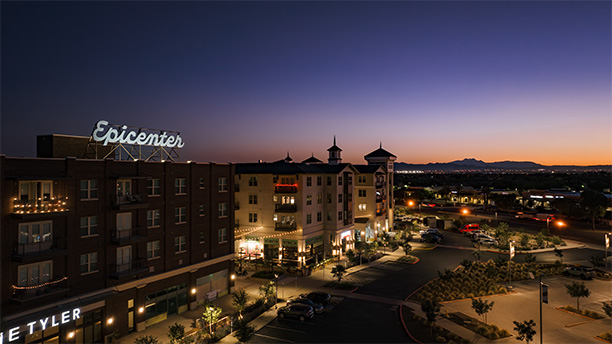
Epicenter, courtesy of Johnston & Co.
Epicenter
Epicenter doesn’t just stand out in its downtown; it is the downtown. Its development is illustrative of how seriously William Johnston, CEO of Johnston & Co., takes the stewardship of Agritopia as his family’s legacy to the Gilbert area from its roots as their family farm.
“As Agritopia grew — and the Gilbert region grew and the neighborhoods around it were growing — we understood the importance of density,” Johnston says. “Density helps the walkability as well as creating community and a little bit of a different feel from the horizontal [development] we were all so used to in the Valley.” Noting the importance of adding a downtown to the other components of Agritopia, he explains, “In most downtowns there is a vertical element of residential over retail. Adding the vertical element to create our downtown and become a focal point in this part of Gilbert was an important piece for us as well.”
The Tyler is Epicenter’s residential component — 320 high-end luxury rental units from studios to three bed/three bath units. Developed by Streetlights Residential — which, Johnston points out, approaches every apartment project as unique to its setting and location — The Tyler’s brownstone architecture furthers a downtown feel. Also important to Johnston is Streetlight Residential’s philosophy, “Even though we’re building apartments, it’s still someone’s home.”
Taking a very intentional approach to creating the commercial component, the Epicenter team surveyed the Agritopia residents about the center during its conceptual stage, asking them, “What’s missing that you’d like to walk to on a pretty regular basis?” From there, they made a list of who they thought was the best in Arizona in those categories. While willing to go outside Arizona if necessary, the aim was to “create a centerpiece highlighting the best of Arizona within a singular project that isn’t a big mall.”
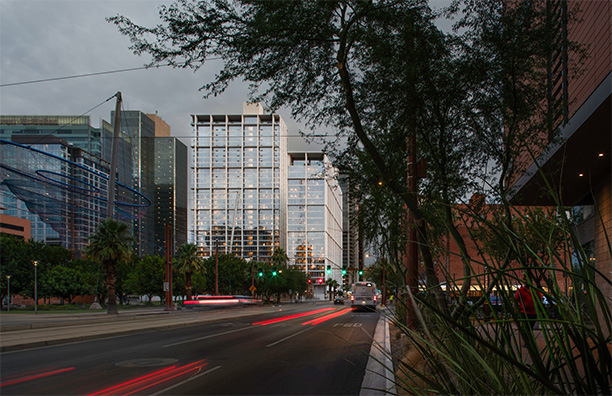
Central Station, photo by Matt Winquist, courtesy of Multistudio
Central Station
Central Station is a transit-oriented, public-private mixed-use redevelopment designed by Multistudio. Noting its core value comes from its location on a major transit hub, adjacency to ASU Downtown and Civic Space Park, and its ability to reshape a constrained civic site into a 24/7 urban destination, Steve Valev, associate principal at Multistudio, describes the project also as a response to Phoenix’s growth and downtown densification.
“Central Station includes a mixed program centered on two towers: a 33-story market-rate residential tower and a 22-story student housing tower. Across the project, the program includes 338 apartments, 629 student beds, and about 7% of the east tower as workforce housing, along with office and retail uses. There is approximately 70,000 square feet of office space, about 30,000 square feet of retail, and roughly 435 parking spaces in a below-grade structure,” Valev says. He notes that mix makes sense because the project is meant to be active throughout the day and serve multiple user groups: Housing supports the downtown residential base; student housing ties directly to ASU; office space adds daytime employment; and retail/restaurant uses activate the street and transit hub. “Parking is included, but the project is clearly designed around transit access first, not car dominance.”
In fact, the biggest incentive for this development, Valev shares, is the efficiency of its location: Central Station sits on a 2.5-acre site in the center of downtown Phoenix, directly tied to the city’s bus and light-rail network and close to ASU Downtown, Civic Space Park and employment centers. “That makes the land unusually valuable for density, as the site already functions as a mobility hub, allowing the project to capture riders, students, workers, residents and visitors in one place.”
Notable are Multistudio’s design innovations to accommodate Phoenix’s climate. Valev points to deep overhangs, arcades, canopies, breezeways and a façade strategy tuned to solar orientation that provide shade and reduce heat gain in the desert environment. “Additionally, he says, “We implemented a reduced palette of glass and EIFS and used prefabrication to simplify construction and improve performance.”
Another notable aspect of Central Station Valev points to is how the building activates the ground plane. “Instead of treating transit as something to hide, the design wraps residential lobbies, retail fronts and circulation around the bus bays and light-rail interfaces so the station becomes part of daily urban life — urban vitality, if you will.” And he cites the fact that the project is targeting LEED Gold and Fitwel certification as further indication that health, comfort and sustainability are integral to the design.
“The project is tied to changing demographics and a broader move toward density and housing at the heart of the city,” Valev says. “Downtown Phoenix is becoming more popular as a place to live and work, and recent projects emphasize walkability and access to public transportation. Central Station appeals to students at ASU as well as young professionals, indicating that the market is shifting toward urban, mixed-income, transit-served living.”
Valev suggests Central Station is best understood as an urban-repair project, noting it converts a utilitarian bus station into a civic, shaded, pedestrian-friendly gateway while preserving transit access and public circulation. “That makes it relevant not only for development but also for downtown placemaking and transit modernization.”
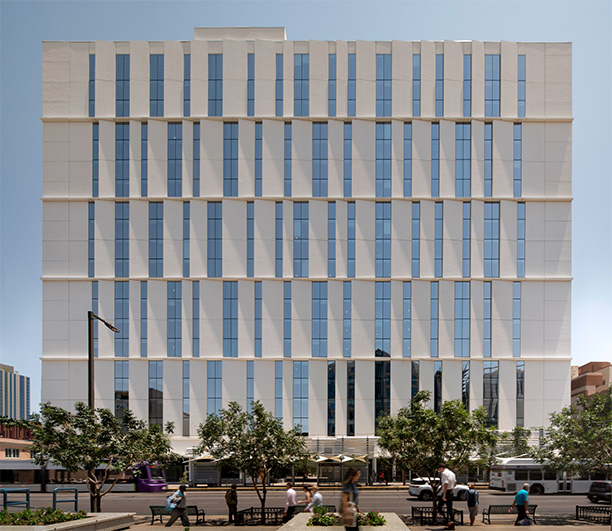
Central Station, photo by Matt Winquist, courtesy of Multistudio
The biggest incentive for this project is the efficiency of its location, Valev says. Central Station sits on a 2.5-acre site in the center of downtown Phoenix, directly tied to the city’s bus and light-rail network and close to ASU Downtown, Civic Space Park and employment centers. “That makes the land unusually valuable for density, as the site already functions as a mobility hub, allowing the project to capture riders, students, workers, residents, and visitors in one place.”
And then there’s the public-private structure, which is another incentive. “The City of Phoenix retains ownership of the land and transit operations, while private partners build the towers under a long-term ground lease, allowing the city to leverage public land for private vertical development without giving up transit control,” Valev explains. “That structure helps justify a higher-density project because the vertical uses support the public transit function and add value to otherwise underutilized land.”
He notes Medistar and GMH deliberately chose not to pursue certain tax incentives available to them, reinforcing their role as strong partners to the City and their commitment to delivering a project that benefits the broader community — “especially in Phoenix, where sensitivity around developer incentives is high.”
Challenges and advantages were two sides of the same constraints: “Central Station is on a tight downtown parcel with active transit operations on both sides, which creates major coordination issues for foundations, truck access, utility relocation, and phasing. Construction also had to deal with live light-rail infrastructure, power-line adjustments, easements, and a new substation, which is unusual for a downtown project.
“At the same time, those constraints are an advantage because the project already has transit, visibility, and civic relevance built in. The complicated site gives it a strong identity and a marketable story, but it also raises costs and requires sophisticated logistics and collaboration among the city, designers, utility providers and contractor. In other words, the biggest development risk is also one of its biggest competitive advantages.
“Additionally, at the project’s outset, the team decided it was important to bury the parking garage — an especially challenging feat, given that we were digging into bedrock. It was a financial commitment for the developer team, but it opened up the ground floor, providing further opportunities for retail spaces that will further activate the streetscape.”
Valev believes the broader region also supports that thesis, noting Greater Phoenix has been one of the nation’s fastest-growing metro areas, which creates pressure for more housing and mixed-use development. “The project is both a response to growth and part of Phoenix’s effort to make downtown more urban, dense, and transit-oriented.”
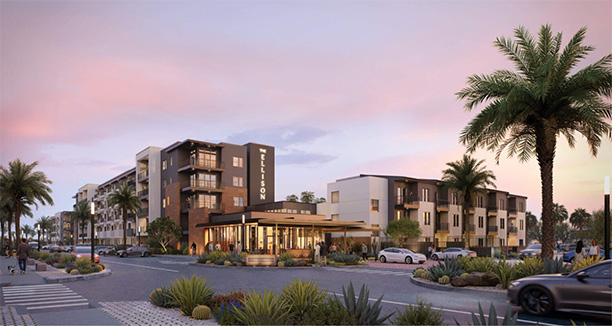
The Ellison, courtesy of Meridian West
The Ellison
The Ellison kicks off the development of The District Downtown, a 45-acre mixed-use development located at the northwest quadrant of Arizona and Pecos avenues in Chandler. In fact, this location and its freeway frontage along those avenues is one of the significant factors in creating this mixed-use development, says Greg Gienko, a principal at Meridian West, which, along with Stillwater Capital and Origin Investments, is developing the project. “It is the gateway to downtown Chandler,” he says.
Influence for the project, Gienko says, “stems from older cities and the way they incorporated retail, office and residential. “They really had it figured out.” Noting that, historically, that mix of uses was vertical, with retail at street level, offices above and residential on the upper floors, he says, “Our development will be more horizontally integrated but remains focused on live, work and play.”
Emphasizing its mixed-use design, he says it will feature most primary commercial products, beginning with The Ellison, which launches development and will include 50 studio units, 211 one-bedroom units, 110 two-bedroom units and nine three-bedroom units.. Parcel II within the project will include 50,000 square feet of retail space which will support the new apartment community and the hotels planned for the site. Parcel II will also be where restaurant and entertainment establishment will be located.
The Ellison’s contemporary design will blend modern architectural elements with the natural beauty of the Sonoran Desert. The community, with three-, four- and five-story buildings, will feature warm earth tones, clean lines and expansive balconies that frame breathtaking desert sunsets. Thoughtfully integrated desert landscaping — including native palms, agave, and cacti — will create an authentic Arizona aesthetic while enhancing the pedestrian experience along Pecos Road.
According to Gienko, the retail components in the development are targeting, and having discussions with, the types of retailers that support residential communities. “This includes coffee shops, quick-serve restaurants and other service-oriented retailers,” he says, noting these are also the types of tenants that will support the hotel users.
“Two office buildings are currently planned, but the work-from-home model that remains in full strength even after COVID makes the financing and delivery of office space very challenging,” Gienko says. He shares that strong interest has been expressed for medical office uses, including urgent care and health system facilities, which would allow one or more of the parcels targeted for office use to be converted.
“With a site that is so visible and one that serves as the gateway to Downtown, there has been a lot of input,” Gienko says, noting it has been a time-consuming, carefully executed process. “It has required lots of navigation. But that’s for the benefit of all concerned.”
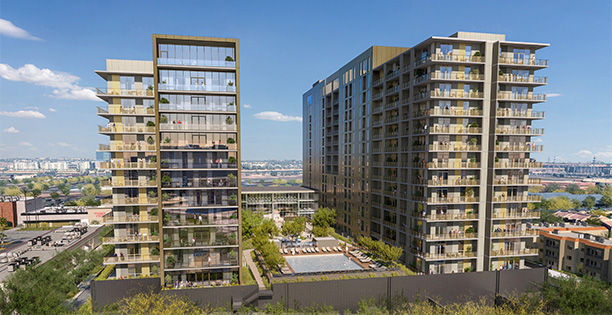
Revelry, courtesy of The Empire Group of Companies
Revelry
Another project by Empire Group’s Aspirant Development is Revelry in Tempe, comprising two towers rising 17 and 15 stories with 533 residential units and approximately 5,500 square feet of retail space on the first floor across two suites, with an additional 10,800 square feet on the second floor. Construction is expected to begin this summer, according to Aspirant’s Jacobs, who notes, “High rise projects are more complicated buildings that take longer to design and longer to permit. There are also more design, construction and inspection implications as it relates to structure, enclosure and especially when it comes to fire/life safety issues.”
The project is designed to rival top urban high-rise communities nationwide and features such elevated lifestyle amenities as pickleball courts, wellness spaces, lounges with a bar and fireplace, a golf simulator and a dog spa. The community also includes a resort-style pool and landscaped 27,000-square-foot outdoor deck, co-working spaces and coffee bar, a state-of-the-art fitness center, onsite garage self-storage and a bike room.
Observing, “Tempe continues to evolve as a dynamic urban environment where people want to live and work,” Jacobs describes Revelry’s location on the southeast corner of Rural Road and University Drive as “one of Tempe’s most active intersections.”
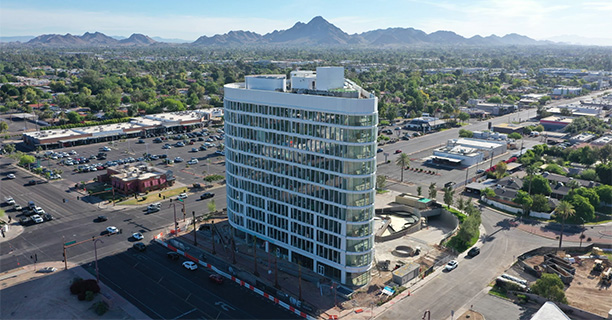
One Camelback, courtesy of Kinella Capital
One Camelback
The long stagnation for the high-rise on the southeast corner of Camelback Road and Central Avenue recently ended. “We were able to acquire the property at a strong basis, well below replacement cost, which created a unique opportunity,” says T.K. Stratton, principal at Kinella Capital. Noting the location is also a major driver, he says, “One Camelback sits at one of the most coveted addresses in Phoenix.”
The project includes 163 luxury apartment residences along with retail spaces on the ground level. Noting a clear shift toward higher-density, walkable living, Stratton observes, “Many people want a luxury lifestyle without taking on the cost and responsibility of ownership. Projects like this give them that flexibility while still delivering a high-end experience in a great location.”
Of the building, Stratton says the design itself is really the standout. “Every unit has floor-to-ceiling glass with unobstructed views, which is rare in Phoenix. The rooftop pool and amenity areas are positioned to take full advantage of the skyline. It’s also located in one of the most walkable neighborhoods in the Valley, which adds to the overall experience.”
The building’s large atrium presented a unique attribute as well as a challenge. “Atrium structures come with added life-safety and code requirements, especially when updating a project to meet current standards,” Stratton explains. “It takes careful coordination to get that right, but the result is a much more open and dynamic living environment for residents.”
For the retail component, Kinella Capital is taking a very intentional approach, with a focus on uses that enhance the day-to-day lives of residents, particularly in areas like wellness, health, and high-quality service-based businesses. This could include concepts like boutique fitness, wellness studios, or curated food and beverage that complement a walkable lifestyle. “We’re being selective about tenancy to ensure it reflects the quality of the building and the expectations of the people who will live there,” says Stratton, explaining that, because of the visibility and prominence of the location, it’s important the retail aligns with the level of the residential experience. “We’re still in the early stages of finalizing tenants, but the guiding principle is simple: Every retail partner should add value to the building, not just occupy space,” he says.
“This is one of the most visible and well-trafficked corners in Phoenix, which creates strong opportunities for retail tenants while supporting a walkable, active environment for residents.”