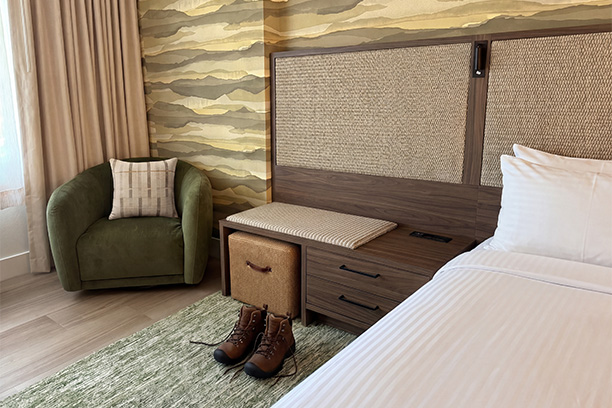
Renovation of the guest rooms was only part of Gensler’s project for The Grand Hotel, located just south of the Grand Canyon; photo courtesy of Gensler
The design industry has spent years talking about experience. Hotels, restaurants, workplaces and mixed-use developments all aspire to create memorable moments that keep people coming back.





But there is a challenge: Memorable experiences cannot be manufactured.
Amenities can be replicated and beautiful interiors can be copied. What separates one place from another is often something far less tangible: the feeling that someone anticipated and cares about a guest’s needs before the individual even has a chance to ask.
That is hospitality. Not hospitality as a building type, a service standard or a design style. Hospitality as a verb.
Perhaps the most important shift occurring in hospitality design today is the recognition that experiences are not something a space delivers on its own. It is a combination of how decisions are made throughout the design process. The spaces themselves are simply the stage.
An experience is nothing without the memory that follows. An example of mine happened six months after the Global Ambassador opened, earning my eternal loyalty to this local business. They helped me facilitate a great afternoon for my daughter and her friends’ senior ditch day at the Pink Dolphin pool. The day greatly exceeded expectations, with a stunning cabana, a lot of sunshine and a group of delighted friends. From the initial booking to pulling away from the valet, every detail was thoughtfully executed. This was reinforced by photos of pure joy and unsolicited texts from my daughter, her friends and even their moms!
The challenge is that experiences like this have to be authentic. A venue can’t suddenly be hospitable because the economy says it’s a necessity. For The Global Ambassador, it wasn’t about the cabana or the mocktails. It was an ingrained approach, established before they even opened their doors, that created a truly memorable day during this right-of-passage for a group of high school seniors. That doesn’t happen if hospitality stops at the design of the space.
How Hospitality Comes to Life
For decades, hospitality design has largely centered on the guest. That’s understandable. Guests are the customers, the reviewers and the source of revenue. Yet some of the most impactful hospitality decisions happen far away from public view. Increasingly, designers and operators are recognizing that exceptional guest experiences are born from exceptional employee experiences. When people are expected to deliver hospitality every day, the spaces supporting them should be designed with the same level of care.
A case study exemplifying this is The Grand Hotel, just south of the Grand Canyon. Initially, the project followed a familiar path to improve the guest experience, focused specifically on a partial renovation dedicated to the guestrooms and corridors, all within a strict budget. But as the process evolved, the focus shifted.
Time was spent with the general manager discussing operational challenges, identifying aspects that weren’t immediately visible but were deeply impactful. This included shelving that was too high and deep, making cleaning unnecessarily difficult. Minor inefficiencies like this compound over time, affecting team members’ daily experience and increasing fatigue.
Most people will never fully know the extent of the journey taken to design their environment. Guests will experience an intentional place to sit for unlacing hiking boots after a day at one of the natural wonders of the world, while team members will benefit from changes aimed at reducing stress after a long shift.
That’s hospitality as an action.
It Shows Up in Unexpected Places and Unexpected Ways
Hospitality isn’t limited to hotels. It can elevate workplace breakrooms, stadium locker rooms, industrial facilities or any environment involving human interaction. Gensler recently earned a RED Award for the hospitality lens taken when designing a data center for Comarch. This recognition reinforces the importance of listening to our clients as well as the trends happening in our industry.
Sometimes it’s in the big moves: rethinking a floor plan, challenging an owner’s program or asking questions a client might not expect. Other times, it’s in a small gesture like showing up with donuts to the final punch walk after hearing a client’s earlier comment about what’s missing in their town. Both signal the same thing: We all need to pay attention. And the team at The Grand Hotel thought the donuts were delicious!
The ROI of Hospitality
A foundational resource of this emerging concept is Will Guidara’s book “Unreasonable Hospitality.” One of the most impactful concepts for all service-related industries is “Service is black-and-white, Hospitality is color.” It captures the intentionality behind every design decision and every spontaneous interaction.
For business owners and operators, the most crucial takeaway is that hospitality isn’t just an industry. And it isn’t something to add at the end of a project. It is something ingrained in the concept from the beginning so that it stays with people long after they’ve left. The strongest measure of a hospitality-driven project isn’t just that a guest or customer notices the design. It’s what they share about the experience with their friends. Or their moms.
 Joanne Hertel co-leads a studio in Gensler‘s Phoenix office. With a career rooted in hospitality interiors, Hertel has led the delivery of a wide range of project types, including restaurants, hotels and day spas.