As data center development expands across the Phoenix region, questions about water use have moved quickly from engineering discussions to the center of public conversation. For an industry built on reliability and efficiency, the challenge is clear: How can digital infrastructure scale responsibly in one of the most water-conscious regions in the United States?






Few topics generate more attention in the Southwest than water. Arizona’s long-term water planning has been shaped by decades of growth, climate variability and a shared understanding that the region’s resources must be managed carefully. In fact, Arizona uses roughly the same amount of water today as it did in the 1950s, despite massive population growth. As data center development expands in the Phoenix metro area, water use has become one of the most visible questions raised by policymakers, communities and industry leaders alike.
These conversations are unfolding at a particularly important moment for the region. Arizona is currently engaged with six other Colorado River Basin states in negotiations to establish the next set of operating guidelines for the Colorado River, which supplies water to tens of millions of people across the Southwest. While the final framework is still being determined, there is broad recognition that all users of the river — including municipalities, agriculture and industry — will need to reduce consumption over time. In this context, water conservation is not simply an environmental goal; it is a practical necessity shaping how growth and development are evaluated across the region.
For data center developers, this reality means water considerations are now a core component of early project feasibility. In many cases, discussions about water availability, cooling technology and operational efficiency begin alongside conversations about power access and site selection.
Historically, many data centers relied on evaporative cooling systems because of their high thermal efficiency and relatively low energy consumption. While these systems remain appropriate in certain contexts, public scrutiny around potable water use — particularly in arid climates — has accelerated the industry’s adoption of alternative cooling approaches.
Closed-loop cooling systems and “dry cooling” technologies are increasingly being deployed in desert markets to significantly reduce or eliminate operational water consumption. These systems rely primarily on air-based heat rejection rather than evaporation, allowing facilities to operate with minimal or no potable water use. While dry cooling can require higher capital investment and careful evaluation of performance during extreme temperatures, it offers greater certainty in water-stressed regions and aligns more closely with community expectations.
To help quantify performance, the industry has also developed metrics to measure water efficiency. Similar to how Power Usage Effectiveness (PUE) tracks energy performance, Water Usage Effectiveness (WUE) measures how much water a data center consumes relative to the energy it uses, typically expressed in liters per kilowatt-hour. While air-cooled facilities can approach a WUE of zero, most climates require some level of water use; across the industry, an average WUE of roughly 1.9 liters per kWh has emerged as a benchmark many operators aim to improve upon.
Beyond cooling systems, responsible water stewardship can also extend into site design. In desert environments, landscape strategies often prioritize native or drought-adapted plantings, efficient irrigation systems, and stormwater management approaches that help capture and direct rainfall where it can be most beneficial.
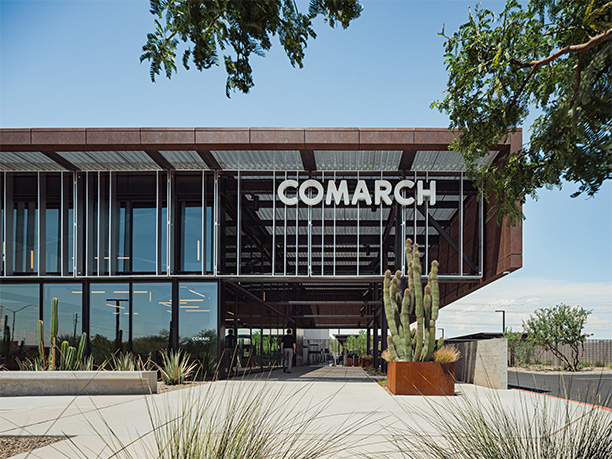
On one recent project for Comarch, the Gensler design team intentionally celebrated the movement of water across the site by channeling rainwater from the roof to an elevated roof drain that gently cascades into a rain garden and desert-adapted landscape at the building’s entry. The feature captures stormwater while creating a visible moment that reinforces the relationship between the building and its environment. Recognizing the project’s successful integration of sustainability into data centers, Comarch won the Industrial Project of the Year at the 2025 Red Awards. In water-conscious regions like the Southwest, these types of strategies demonstrate that conservation measures can extend beyond mechanical systems to become part of the architectural and landscape experience.
The growing focus on water stewardship reflects a broader shift in how data center projects are evaluated. Communities, investors and policymakers increasingly expect developers to demonstrate that large infrastructure investments are compatible with long-term regional resource management. Addressing water use proactively — and communicating those strategies clearly — has become an important part of establishing a project’s long-term social license to operate.
Arizona’s long history of water planning and resource management provides a strong foundation for these conversations. The state’s regulatory framework and extensive groundwater management policies create an environment where responsible development can move forward with clarity and accountability.
The industry is already operating with a new baseline, where water‑cooled facilities are quickly giving way to designs that minimize or eliminate water consumption altogether. For developers, this shift underscores a broader reality: Water stewardship has become a core design expectation, best achieved through early, coordinated planning across teams, utilities and local stakeholders.
 Kaley Joseph, CSI, CDT, LEED AP BD+C, is a sustainability director for Gensler’s Southwest Region and Phoenix office, leading strategies that integrate sustainable design, ESG reporting and community impact into projects. She collaborates with clients to reduce their environmental footprint, ensuring their buildings align with long-term sustainability commitments and industry benchmarks.
Joseph works within Gensler’s Critical Facilities practice area, helping to deliver sustainable and resilient solutions for large-scale projects like data centers. A LEED- and WELL-accredited professional, Fitwel ambassador, licensed architect and certified Construction Document Technologist, she applies technical expertise and leadership to drive sustainable innovation. Kaley’s influence extends beyond her professional work, as she actively advocates for climate-conscious design, regional policy improvements and mentorship.
Photo of Comarch, courtesy of Gensler