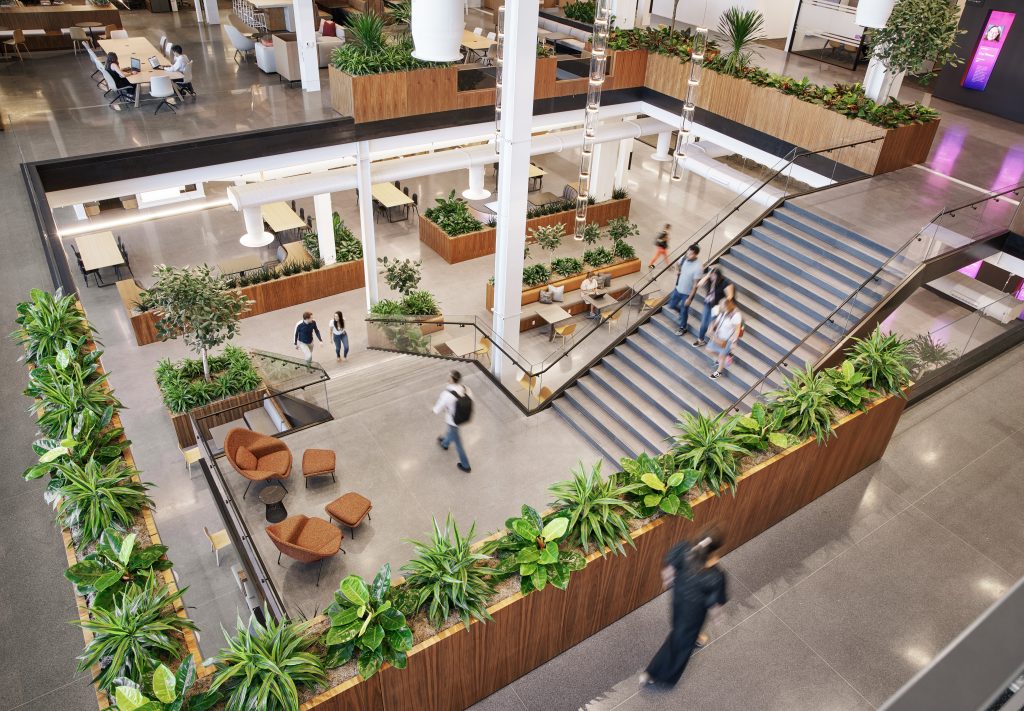
 Insight’s headquarters in Chandler, Arizona, exemplifies how a human-centered, evidence-based design approach can make hybrid work truly sustainable; the space balances flexibility with connection — creating an environment that evolves with people rather than prescribing how they work
At the heigh of the COVID-19 pandemic, there appeared to be a dramatic shift in thinking among occupiers of real estate and workspace. While working from home and activity-based work strategies were adopted by a few organizations pre-pandemic, the pandemic resulted in even the most conservative organizations taking a second look and rethinking their workplace strategies and, more importantly, the role the physical workplace should have for their enterprises. During this time, many organizations adopted hybrid work for a variety of reasons: For some, the lock-downs made it difficult and, in many instances, impossible to work in the physical workplace. Others viewed it as an opportunity to reduce real estate, which in uncertain times was extremely attractive. Still others adapted, realizing that the pandemic was a moment in time to totally reevaluate the definition of work, how it could be conducted and where it could take place. However, by 2023, despite hybrid work and activity-based work strategies being deployed by many organizations, there appeared to be a lack of momentum and enthusiasm for organizations to take the leap into what was for many an untested strategy.






An important issue is understanding the underlying conditions that have impacted and informed this malaise and how we can move beyond their indecision and make better decisions and strategies going forward. There is a need to examine the problem through a lens different from the surveys and analytics that we have become so fond of and that in too many instances have become crutches allowing for indecision and ambiguity. We need to look at the problem through a qualitative lens rather than a quantitative one.
Those organizations on the fence sought data and benchmarking to reassure them of the efficacy of these approaches. But many used the reduction of the health threat from COVID-19 as an excuse to return to their management comfort zones. Why has what was promised in 2020 as the future of work reached such mixed adoptions? With an absence of evidence-based research, I looked back to my 2010 research for a master’s degree in philosophy in organizational design to see if my research methodology could provide a different perspective. My research revolved around decision making in organizations and was titled “Workplace Design Strategies Within Business Organizations: Perception, Power and the Bottom Line.” More specifically, I questioned how decisions around adopting a workplace strategy were made within organizations. I was not judging the value of the adopted strategies but focused on the lens through which organizations evaluated and made decisions to deploy a workplace strategy.
A few key insights from the research comprising 14 global organizations (including government, finance, technology, media and professional services):
- Of these 14 organizations, only two used any form of research to make a decision to adopt a particular strategy.
- Twelve of these organizations adopted their strategy based simply on perceptions of the outcomes (e.g., this strategy would make us more collaborative; this strategy would break down our silos).
- A post-research audit found that 60% of the research participants had abandoned their selected workplace strategy.
- The underlaying rationale behind the majority of these decisions revolved around perception, power or organizational control, and cost savings (the bottom line).
Organizations are requesting data to support their hybrid selection process. The problem is that the research they are looking toward focuses on survey data and benchmarking. But are these data sets adequate in making a decision that has widespread ramifications long term for their workplace? And what are the underlying issues that are not often acknowledged but are implicitly behind the present conundrum of decision-making and indecision?
That workplace strategies are the result of perception rather than evidence-based research is evidenced by the study groups in my research, and this suggests how prevalent irrational decision-making is in business organizations, at least when it comes to workplace strategy decisions. This provides insight into why many organizations that embraced hybrid workplace strategies during the height of the pandemic are now either questioning them or giving up on them altogether.
For real estate and workplace professionals tasked with making recommendations on adopting hybrid strategies, the challenges are enormous, especially since a move to hybrid work is, in large part, entering into uncharted and untested territory. Making decisions without data is often difficult and leaves one open to risk, yet we need to acknowledge that the old rules and modes of decision-making using data-driven analytics and benchmarking are not sufficient for these new challenges and opportunities. Analytics and benchmarking fuel perceptions, and perception-based decision-making results in either failure or paralysis. This new world of hybrid work, in order to succeed, needs to be adopted as a continuous experiment and the future workplace as a laboratory for testing new forms of both work and place that reflect the true needs of each organization.
 Arnold Levin, strategy director at Gensler, brings more than 50 years of experience in design strategy, organizational design, feasibility planning, workplace design and design research with a wide range of global clients. He has combined his research in Organizational Design and Workplace Design methodologies into client-focused design strategies that engage clients in the process to develop innovative workplace solutions.
Did You Know: Gensler, the world’s leading architecture and design firm, is the recipient of the 2025 Honor Award from the National Building Museum.
Photo by Ryan Gobuty, courtesy of Gensler