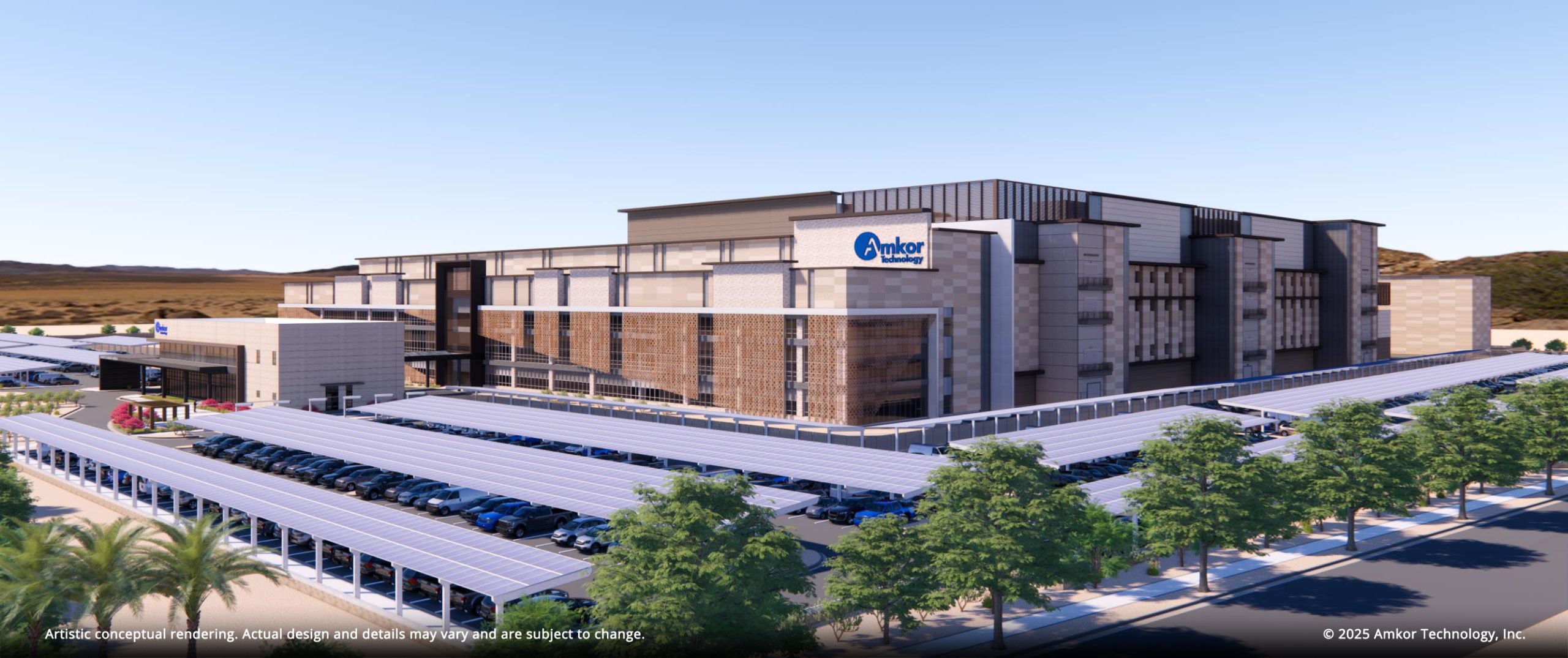
 Imagining the future of Arizona’s semiconductor industry evokes pictures of clean rooms and cutting-edge tools. However, Amkor Technology also wants clean air to be in that picture.
The Tempe-based company, already one of the world’s largest providers of outsourced semiconductor packaging and testing, plans to invest $2 billion in a new advanced facility in Peoria. Two thousand local jobs are expected to be created, as well as an expanded domestic capacity in a sector increasingly seen as vital to national security and economic resilience.







And Amkor executives are quick to point out it’s not just about capacity. It’s about doing it right.
“We are proud to be an American company and have been based right here in Arizona for decades,” said David McCann, senior vice president at Amkor, during a recent public webinar. “It’s important to us to be responsible stewards of the land, air and water.”
The new facility will house state-of-the-art semiconductor testing and packaging operations, but it’s the environmental infrastructure that may set it apart. According to McCann, Amkor’s cleanroom air quality will exceed that of most hospital operating rooms. That’s not just a claim; it’s a design requirement.
Amkor uses a layered system of HEPA filters to remove fine particles from incoming air. Then, the facility’s airflow pushes particles downward from ceiling vents through floor-level collectors, where they’re filtered again before the air is recirculated. Employees in the cleanroom wear full-body suits, nicknamed “bunny suits,” and pass through air showers before entering, minimizing the chance of contaminants.
It’s all standard practice in semiconductor manufacturing, but Amkor is taking it a step further when it comes to what happens next: emissions control.
Before any air is released back into the environment, it’s cleaned through a two-part system. First, a water scrubber dissolves remaining particles. Then, the air is heated to eliminate organic compounds, odors and pollutants, breaking them down into carbon dioxide and water.
To ensure reliability, Amkor has built redundancy into the system, featuring duplicate units that enable maintenance and provide backup. And most notably, the company has pledged to keep its emissions at least 50% below all applicable local, state and federal limits.
Amkor’s broader sustainability roadmap included the creation of this Peoria facility. The company has set a verified net-zero greenhouse gas emissions goal for 2050, with a 55% reduction in absolute Scope 1 and 2 emissions by 2033. These targets are certified by the Science Based Targets initiative (SBTi), and the company also adheres to frameworks such as the Responsible Business Alliance, the Responsible Mineral Initiative and the Sustainability Accounting Standards Board. Amkor has also pledged to reduce water use and waste generation by 20% by 2030.
It’s an ambitious plan for a company that continues to scale operations in lockstep with U.S. semiconductor policy. With more companies reshoring and expanding advanced packaging capabilities in North America, the need for robust infrastructure and public trust has never been greater.
Arizona has tremendous momentum within the semiconductor industry, having surpassed $200 billion in investments and showing no signs of slowing. Peoria’s gain is just another example of that momentum. Facilities like Amkor’s don’t just add jobs and capacity; they raise the bar for environmental responsibility, public engagement and regional planning.
As McCann noted, the company will continue to host webinars to keep the community informed throughout the construction and operational phases. “We want to make sure people have a clear understanding of how we operate and what we value,” he said.
Amkor’s message is clear: Clean chips start with clean processes. And, in the race to build America’s semiconductor future, Arizona is once again leading by example.
Photo courtesy of Amkor